« Venez pour l’AG, restez pour le Bloomsbury Handbook ! »
L’Assemblée Générale du Cercle Ferdinand de Saussure 2025 est convoquée le samedi 20 septembre 2025, à 14 heures (heure de Lausanne), à l’Université de Lausanne, salle CD106 du Château de Dorigny.
La convocation officielle du Président du Cercle est disponible à ce lien.
L’AG du Cercle est ouverte au public : membres du Cercle, passionnés et curieux de passage sont invités à participer.
Cette année, l’AG sera accompagnée de la présentation du Bloomsbury Handbook of Saussure (2025), édité par John E. Joseph, ancien Président du Cercle.
AG et présentation seront également accessibles à distance : un système de retransmission moderne sera mis en place. ⚠️ Attention ! Pour en bénéficier, il est nécessaire de réserver sa place avant le 15 septembre en indiquant votre nom et votre courriel dans le formulaire ci-dessous :
Cahiers Ferdinand de Saussure, volume 76 (2023), édité par John E. JOSEPH, Ecaterina BULEA BRONCKART, Anne-Gaëlle TOUTAIN, Genève, Librairie Droz, 2025, 368 pages, ISSN : 0068-516X, ISBN-13 : 978-2-600-06647-1, € 60,00 Date de première publication : 18 juin 2025 Voir la notice de l’Éditeur. Ce numéro en version numérique : https://revues.droz.org/CFS/issue/view/CFS_76
Table des matières
I Éditorial
John E. JOSEPH, Ecaterina BULEA BRONCKART, Anne-Gaëlle TOUTAIN, À nos lecteurs, p. 5-6
Camiel HAMANS (Adam Mickiewicz University in Poznań), L’importance changeante de l’analogie. Quelques remarques sur l’analogie dans la formation des mots, p. 9-40
Abstract: Analogy is one of the most frequently used terms in the history of linguistics. However, the meaning of the notion differed considerably over the centuries. Consequently, the role that analogy was thought to play in language change also differed substantially. In the first parts of this paper emphasis is on the history of the term analogy, whereas in the final part it will be demonstrated how analogy in its modern sense can be used successfully when applied to non-morphemic word formation. Keywords: Analogy, anomalists, regularity, perception, Schola Hemsterhusiana, Hermann Paul.
Anneli LUHTALA (University of Helsinki), Grammar as a rational art and as an Aristotelian science, p. 41-60
Abstract: In this essay, I have traced the evolution of ancient grammar from an empeiria to a rationalistic art and, during the Middle Ages, further to an Aristotelian science. Throughout this period, grammar continued to borrow tools of analysis from dialectic and Aristotelian physics and became a major subject in the Arts Faculties. All the same, it remained an art which was studied as a means to an end rather than for its own sake. Medieval thought was fundamentally hierarchical, and grammar did not figure among the highest disciplines, which can be studied for their own sake. Keywords: Ancient rationalistic grammar, medieval speculative grammar, ancient syntactic theory, alexandrian philology, empiricism.
Rolf KEMMLER, Synchronic vs diachronic approaches in the descriptions of german nominal inflection in the earliest Portuguese textbooks of the german language (1863-1926), p. 61-83
Abstract: Since the first German language textbook for a Portuguese target audience was published in 1863, the respective authors had to ask themselves not only how to designate the components of the nominal inflection of German nouns, but also how to present them in a classificatory way in order to familiarize their audience with the German declension. Given that the Grimmian diachronic approach was and still is considered authoritative in academic German studies, the question arises as to whether and how the authors of the earliest Portuguese works were guided by this or other approaches. The result will answer the final question of which of the classification approaches might be particularly promising in the context of German as a foreign language. Keywords: German language, Portugal, synchrony, diachrony, Jacob Grimm.
Gonçalo FERNANDES, Carlos ASSUNÇÃO (University of Trás-os-Montes & Alto Douro, Portugal Center for Studies in Letters), 17th-century descriptions of Japanese and Vietnamese and their relevance to the modern politeness principle, p. 83-104
Abstract: The “politeness principle” was coined even before Stephen Curtis Levinson established pragmatics as a linguistic academic field in the early 1980s. However, other relevant works concerning pragmatics were published as early as the 1930s, for example, by Charles Sanders Peirce (1839-1914), Charles William Morris (1901-1979) and Yehoshua Bar-Hillel (1915-1975). On the other hand, there is a common knowledge that Brown & Levinson (1978; 1987) originated the idea of the politeness principle because of the importance of their linguistic politeness studies. Though the 1973 paper by Robin Tolmach Lakoff, “The logic of politeness: Or, minding your p’s and q’s,” can be considered the “birth certificate” of the politeness principle as a linguistic domain, it is often ignored even in specialized papers or books. Based on a 1967 work by Herbert Paul Grice (1913-1988) on the rules of conversation, an as yet unpublished manuscript, Lakoff (1973) summed up the politeness expressions into three rules. Nevertheless, the grammarians and linguists of Asian languages were always particularly interested in describing their relevant expressions and address forms. In 1944, Hsien Chin Hu (Columbia University, New York City) published a pioneering paper concerning “The Chinese Concepts of ‘Face’”, anticipating by 11 years the theory of face in Erving Goffman’s paper “On Face-Work; An Analysis of Ritual Elements in Social Interaction”. 17th-century European grammarians and lexicographers of the Japanese and Vietnamese languages had also aimed to describe the linguistic social relationships’ regulations. In this paper, we study the approaches which three early European grammarians and lexicographers developed to account for the politeness principle in Japanese and Vietnamese in the 17th century, namely João Rodrigues ‘Tçuzu’, S. J. (1562-1633), Diego Collado, O.P. (late 16th century-1638) and Alexandre de Rhodes, S. J. (1593-1660), and their contribution to present-day linguistics. Keywords: History of the Language Sciences, Missionary Linguistics, Address Forms, Face Theory, Jesuits, Pragmatics.
Gerda HASSLER (Université de Potsdam), L’intégration de la catégorie d’aspect dans la description grammaticale, p. 105-127
Abstract: This contribution examines the integration of the notion of aspect in the grammar of European languages, especially in Spanish grammar writing. The hesitant integration of compound verb forms into the description of the conjugation of Romance verbs and the peculiar naming of these verb forms appear to be due to two causes until the 18th century. On the one hand, the authors of the grammars transposed Latin grammar and its terms to the vernacular languages. On the other hand, the authors considered the terms only from a semasiological perspective, deriving the functions of the verb forms from the meaning of the terms. Keywords: Aspect, verbal system, imperfect, completed, definite, indefinite.
Ricardo CAVALIERE, On the profile of Brazilian Portuguese grammar in the 20th century, p. 129-150
Abstract: This work deals with the concept of grammar in Brazil in the 20th century, with special attention to its theological role, the nature of its corpus and the limits imposed on the task of describing the language system in relation to other factors such as variations in language use and style. The study also presents a typological classification of Brazilian-Portuguese grammars throughout the century, based on their profile, their theoretical sources and the corpora they use in their linguistic descriptions. Keywords: Portuguese Grammar, 20th Century, Brazil.
Jesse LUNDQUIST (Princeton University), Saussure on *téi-stems: a generativist avant la lettre?, p. 151-172
Abstract: This paper highlights one remarkable aspect of Saussure’s account of the Proto-Indo-European *tei-/ti-stems: he used an inherently accented morpheme for his reconstruction, viz. an underlyingly accented *-téi-. Based on an analysis of a neglected passage from the end of the Mémoire, and introducing more explicit statements from his posthumously published courses on morphology and on Gothic, I propose that Saussure devised a budding compositional system of morphophonological analysis. I suggest that his underlyingly accented morphemes indicate two levels of abstraction in phonology, forms before and after modification, a remarkable move that foreshadows similar analyses in generative grammar. I focus on his account of Indo-European *-téy-, which remains valuable in assessing this particularly contentious realm of Indo-European morphology, namely accent and ablaut. Keywords: Accent and ablaut, morphophonology, underlying representations, ti-stems.
John E. JOSEPH (University of Edinburgh), Ferdinand de Saussure, le post-structuraliste, p. 173-184
Abstract: Understanding the linguistic work of earlier times demands that it be read in the context of when and why it was written. This effort is both aided and impeded by our habit of packaging the past into periods and doctrines that entail inevitable oversimplifications and distortions. This paper contends that structuralism is conceived in such a distorted way – including the view that we are supposedly “post” it. Inspired by a student who referred to Saussure in an exam as a post-structuralist, I take up the case for seeing him as exactly that, in terms of how we generally conceive of structuralism, with a view to improving our understanding of what structuralist linguistics was – indeed, perhaps still is. Keywords: Ferdinand de Saussure, structural linguistics, structuralism, post-structuralism, Henri Meschonnic, J. R. Firth, Jacques Derrida, Maurice Merleau-Ponty.
III Lectures critiques
Sébastien MORET, Saussure en espéranto. À propos de la première traduction du Cours de linguistique générale en espéranto, p. 187-206
Reinier SALVERDA, A global survey and corpus of translations of Saussure’s Cours (1928-2014) and Écrits de linguistique générale (2002-2021), p. 211-238
Unde venis et quo tendis ? Conférences sur l’histoire de la linguistique et de la sémiotique, Université Palacký, Olomouc, automne 2023 (Israel Chávez), p. 347-351
Cahiers Ferdinand de Saussure, volume 75 (2022), édité par Ekaterina VELMEZOVA, Genève, Librairie Droz, 2025, 248 pages, ISSN : 0068-516X, ISBN-13 : 978-2-600-06615-0, € 63,30 Date de première publication : 17 février 2025 Voir la notice de l’Éditeur. Ce numéro en version numérique : https://revues.droz.org/CFS/issue/view/CFS_75
Table des matières
I Éditorial
Ekaterina VELMEZOVA (Université de Lausanne / Université de Tartu), À nos lectrices et à nos lecteurs, p. 5-6
Gabriel BERGOUNIOUX (Université d’Orléans), De l’emploi du génitif absolu en sanscrit (1881) et l’étude de la morphologie sanskrite dans l’œuvre de Saussure, p. 9-24
Abstract: The limits of the subject that Saussure chose for his PhD were a reaction to the requirements of an academic degree. The objections to the Mémoire had convinced him to restrict himself to a philological work whose data he could circumscribe and analyse in a limited time. This article examines the design of the PhD in order to establish its main results, highlighting a number of points of interest such as the artefacts of literacy on grammar, the production of interpretation shared between inflection and context or the attribution of a value (concessive clause), despite the absence of a direct formal mark. The second part examines Saussure’s other contributions on the Sanskrit language as a way to exemplify Indo-European facts or to come to terms with Hélène Smith’s glossolalia. Keywords: Sanskrit, Morphology, Inflection, Glossolalia.
Giuseppe COSENZA (Università della Calabria), L’émergence et l’évolution de la sémiologie chez Saussure (1881-1894), p. 25-51
Abstract: This paper is part of a reconstruction of Ferdinand de Saussure’s semiology. The reconstruction is based on a terminological inquiry into different terms related to semiology (fr. sémiologie). The occurrences of terms were extracted from different Saussurean texts written during the period between 1881 and 1911. The paper also contains two hypotheses about the source of Saussure’s semiology. However, for reasons of space, the detailed analysis of the values of the term “semiology” and related terms is restricted to the period 1881-1894. Our analysis takes up and extends Chidichimo’s essay (2014) on the term “semiology”; the article integrates and clarifies Chidichimo’s analysis of the term “semiology” into a broader and more precise view. Our study shows that the emergence of semiology as a science of signs went through several stages in Ferdinand de Saussure’s thought before being established as a science. Keywords: Semiology, Sémiologie, History of semiotics, Theory of signs.
Franco FANELLI (Chercheur indépendant), F. de Saussure and inner Speech. A reading proposal of CLG 98, p. 53-66
Abstract: The purpose of this article is to highlight what topics are actually covered in a particular short passage of the Cours de linguistique générale and to propose its correct interpretation. The passage may seem obscure as it lacks, in our view, an explicit reference to inner speech. The manuscript sources confirm the omission and support the argument that in this passage Saussure was thinking precisely of the langage intérieur. In the last part of the article, we examine the Saussurean sources about inner speech. In particular, we consider La parole intérieure by Victor Egger (1881), a wide-ranging book that deals with inner speech. The fact that Saussure read and annotated this work is a relevant clue that inner speech is truly a topic of the passage we discuss in this essay. Keywords:Course in General Linguistics, Manuscript sources, Inner speech, Victor Egger.
Ahmed KHARBOUCH (Université Mohamed Premier, Oujda, Maroc), La dualité anthropologique convention sociale / sujet individuel dans la sémiologie saussurienne, p. 67-82
Abstract: Saussure is generally recognized as the one who, together with Peirce, laid the foundations of modern semiotic thought. His influence, like that of the American, is indeed diffuse and crosses different schools and trends in current semiotic research. An essential feature, however, differentiates him from the American philosopher, namely that he puts forward, in his conception of the “science of signs”, a very clear anthropological orientation. This is highlighted, as we will try to show, in the way in which he conceives semiosis as the encounter between the particular “thought” of the individual and the different semiological institutions of society. This necessary encounter within the semiological fact between the subject and the convention constitutes the central duality of the semiotic thought of the Genevan and explains why his semiology is not a formal science. Keywords: Duality, Anthropological aiming, Semiological institution, Speaking subject, Collective consciousness, Social convention.
Martina MECCO (Sapienza University of Rome / Charles University of Prague), Roman Jakobson and Slavische Rundschau (1929-1939), p. 83-100
Abstract: In 1929-1939, during his stay in Czechoslovakia, Roman Jakobson collaborated intensively with the Prague German-language journal Slavische Rundschau (Slavic Review). The periodical was founded and run by two German Slavists affiliated with the Deutsche Universität Prag, Gerhart Gesemann and Franz Spina. Being the head of Slavische Rundschau’s Ostslavisches Referat (East Slavic Section), Jakobson had to handle the correspondence with scholars from Russia, Ukraine and Belarus and edit or co-edit their contributions. Slavische Rundschau’s collection, which was never processed, contains an extensive number of materials related to Jakobson’s activity in the journal. This article aims to give a preliminary analysis of these materials (correspondence and editorial documents). Due to their importance, particular attention will be given to correspondence Jakobson received from Russian, Ukrainian, and Belarusian scholars (mainly linguists or philologists) and institutions. Keywords: Roman Jakobson, Slavische Rundschau, Correspondence, Czechoslovakia, German press.
Anne-Gaëlle TOUTAIN (Université de Berne / Laboratoire «Histoire des théories linguistiques»), Linguistique et biologie : de l’idéologie scientifique au scientisme, p. 101-120
Abstract: In this article, we show that the incursions of linguists into biology, from Schleicher through aphasiology to evolutionary linguistics, have created an unchanged space, the permanence of which lies in the absence of a break with the representation of language as an entity. This break, made by Saussure, nonetheless remained a dead letter in linguistics, whose relationship with biology has since been placed under the sign of scientific ideology, in the sense of Georges Canguilhem, coupled with reductionism. These relationships are established in place of a definition of language, and within the framework of the definition of common knowledge. Theoretical elaboration is then replaced by the spatialization and temporalization of this definition, spatialization and temporalization constituting the elective axes, respectively, of aphasiology and evolutionary linguistics. Keywords: Synchrony/Diachrony, Organicism, Naturalism, Structuralism, Cognitivism, Biolinguistics, Evolutionary linguistics.
Denis ZOLOTUKHIN (Université Paris Cité / Laboratoire «Histoire des théories linguistiques»), Traduire « De la double essence du langage » en Russe, p. 121-141
Abstract: The translation of Saussurean texts and terminology has become a science in its own right. The discovery of new documents during the 20th century provided material that not only advanced this field but also presented numerous challenges, compelling translators to rethink existing translations. The aim of this paper is to demonstrate the features of the translation process into Russian of the manuscripts titled De la double essence du langage discovered in 1996. Going through the history of existing Russian translations of Saussure’s texts, the author takes into consideration terminological, philological and epistemological aspects of the translation of this text which remains largely unknown to Russian scholars, as well as suggesting strategies that can be applied to solve different issues caused by the particular form, content and context of these manuscripts. Keywords: Scientific translation, Russian language, Saussurean terminology, Saussurean manuscripts, De la double essence du langage.
III Documents
John E. JOSEPH (University of Edinburgh), Saussure’s Last Linguistic Studies: An Introduction to and English Translation of “On Latin compounds of the agricola type” (1909) and “Indo-European adjectives of the caecus ‘blind’ type” (1912), p. 145-171
Cindy GERVOLINO (Université de Franche-Comté), Perspectives croisées sur le diagramme et le geste. À propos de Francesco La Mantia, Charles Alunni, Fernando Zalamea (dir.), Diagrams and Gestures. Mathematics, Philosophy and Linguistics, Springer, Londres, 2023, p. 187-200
American Linguistics in Transition. From Post-Bloomfieldian Structuralism to Generative Grammar, Frederick J. Newmeyer (ed.), Oxford, Oxford University Press, 2022 (G. Cosenza, C.A. Forel), p. 203-207
Ferdinand de Saussure in Contemporary Semiotics, Bent Sørensen and Torkild Thellefsen (eds.), Bordeaux, Presses Universitaires de Bordeaux, 2024 (F. Murano), p. 208-212
Ferdinand de Saussure today: semiotics, history, epistemology, Ekaterina Velmezova and Emanuele Fadda (eds.), special issue of Sign Systems Studies, 50/1, 2022 (T. Drobysheva), p. 213-218
De l’héritage intellectuel Saussurien à l’école doctorale 2023. «L’histoire de la linguistique dans le miroir de l’histoire de la sémiotique» (D. Fargues, D. Zalesskaya), p. 229-235
Pour laisser les saussuriens se préparer dûment à l’anniversaire, nous donnons aujourd’hui une annonce officielle.
Lors de la dernière Assemblée générale, un seul tour de scrutin a suffi pour élire Ekaterina Velmezova comme nouvelle présidente du Cercle Ferdinand de Saussure. Ekaterina Velmezova, déjà membre du Comité de rédaction des Cahiers Ferdinand de Saussure, est professeure ordinaire dans la Section de langues et civilisations slaves et de l’Asie du Sud (SLAS) de l’Université de Lausanne. Elle succède à John E. Joseph, président du Cercle depuis 2019. Ekaterina Velmezova prendra se fonctions à partir du 1er Janvier 2025.
Le Comité du Cercle Ferdinand de Saussure tient à remercier chaleureusement John E. Joseph pour avoir efficacement mis toutes ses compétences et son humanité exquise au service du Cercle dans un délicat moment de passage.
Le Comité salue la nouvelle présidente du Cercle Ferdinand de Saussure et lui souhaite bon travail !
L’Assemblée Générale du Cercle Ferdinand de Saussure est convoquée le samedi 5 Octobre 2024 à 14 heures (heure de Genève), à l’Université de Genève, site Unimail, salle 4193.
La convocation officielle du Président du Cercle est disponible à ce lien.
Cette année, l’AG sera accompagnée d’une table ronde en souvenir de René Amacker (1942-2024), ancien Président du Cercle (1996-2002).
Colloque et AG sont publics, et seront accessibles à distance : un dispositif artisanal de téléportation sera mis en place. Attention ! Pour en profiter, il faut réserver sa place avant le 4 octobre en communiquant nom et courriel dans le formulaire ci-dessous :
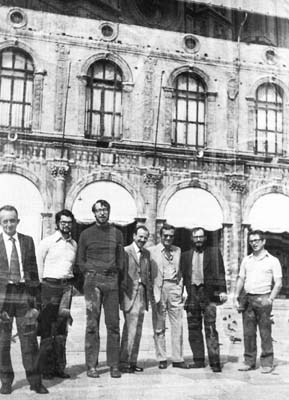
Bologna 1973, Congrès International des Linguistes. Depuis la gauche : Tullio De Mauro, Daniele Gambarara, René Amacker, Rudolf Engler, Enzo Golino, Umberto Eco, Franco Lo Piparo.
[À] mon avis, c’est en partant de ce qu’il tirait de l’observation de la langue – c’est-à-dire des lois ou des « théorèmes » de la linguistique – que Saussure en est venu à postuler le cadre pour ainsi dire vide qu’est chez lui la sémiologie ; c’est que la sémiologie, une fois qu’elle aurait été constituée, devait simplement fonder et déterminer la linguistique, c’est-à-dire justement le point de départ de Saussure. Il me semble donc que, selon une reconstruction idéale de sa démarche, la sémiologie, définie au moyen des instruments conceptuels fournis par la linguistique (à un niveau N de la formalisation), était conçue en particulier pour fournir les instruments conceptuels (de niveau N–1 dans la formalisation) propres à définir formellement, parmi d’autres disciplines de niveau N, notamment la linguistique. J’attribue donc à un effet de la réflexivité la raison d’être de la sémiologie, qui ne sert visiblement à rien d’autre chez Saussure qu’à donner à la linguistique une caution scientifique dont la linguistique assure elle-même le financement. Si ces vues ne sont pas totalement chimériques, on conçoit que la sémiologie saussurienne en soit restée pour l’essentiel à l’état de projet : les moyens, notamment formels, qui auraient été indispensables à son développement échappaient à Saussure ; mais le seul fait qu’il en a postulé l’existence prouve, à mon sens, que son épistémologie était constructiviste. […]
Enfin, maintenant que les raisons scientifiques et non pas seulement personnelles de son ‘silence’ nous sont devenues intelligibles, on conçoit qu’il n’ait rien voulu publier : poussé par la contrainte de la langue (réalité mouvante et « sans analogue » qui longtemps parut lui échapper dans la mesure même où il pensait la saisir), Saussure s’est engagé sur un terrain épistémologique qui se dérobe sous vos pieds dès que vous y prenez pied.
Un mot pour finir. Tout ce que nous tirons des notes autographes et même des notes des cours de linguistique générale est foncièrement fragmentaire ; comme dans le cas d’Héraclite, les sources que nous lisons et interprétons sont évidemment insuffisantes à nous représenter pleinement l’état et l’évolution de la pensée saussurienne : les notes autographes indépendantes des cours sont anciennes et disparates ; quant aux cours, Saussure n’a pas pu leur donner la forme qui eût convenu à l’état de sa réflexion […]. Ainsi avons-nous été à jamais privés des idées que, fascinés nous-mêmes par l’épistémologie ‘héraclitéenne’ qu’il nous enseigne, nous cherchons chez lui, sans que nous puissions être assurés de les y trouver jamais : car seule une « méditation exclusive » de plusieurs mois, comme il le confiait à Léopold Gautier, lui aurait permis de leur donner forme, voire simplement de les faire exister.
Nous utilisons des cookies pour vous garantir la meilleure expérience sur notre site web. Si vous continuez à utiliser ce site, nous supposerons que vous en êtes satisfait.