Traditionnellement, l’AG est un événement ouvert : Genevois, Praguois et autres curieux égarés dans les couloirs de l’Université sont les bienvenus ; les marconistes du Cercle se chargeront de transmettre les travaux de l’AG sur l’éther, pour ceux qui ne pourraient y assister en personne.
⚠️ Attention ! Pour obtenir la fréquence, il est nécessaire de s’inscrire avant le 610 septembre en indiquant nom et courriel dans le formulaire ci-dessous :
Nous sommes désolés, mais les inscriptions sont closes et votre adresse n'a pas été prise en compte. Pour toute question, veuillez contacter la Task Force (lataskforce@cercleferdinanddesaussure.org). Merci !
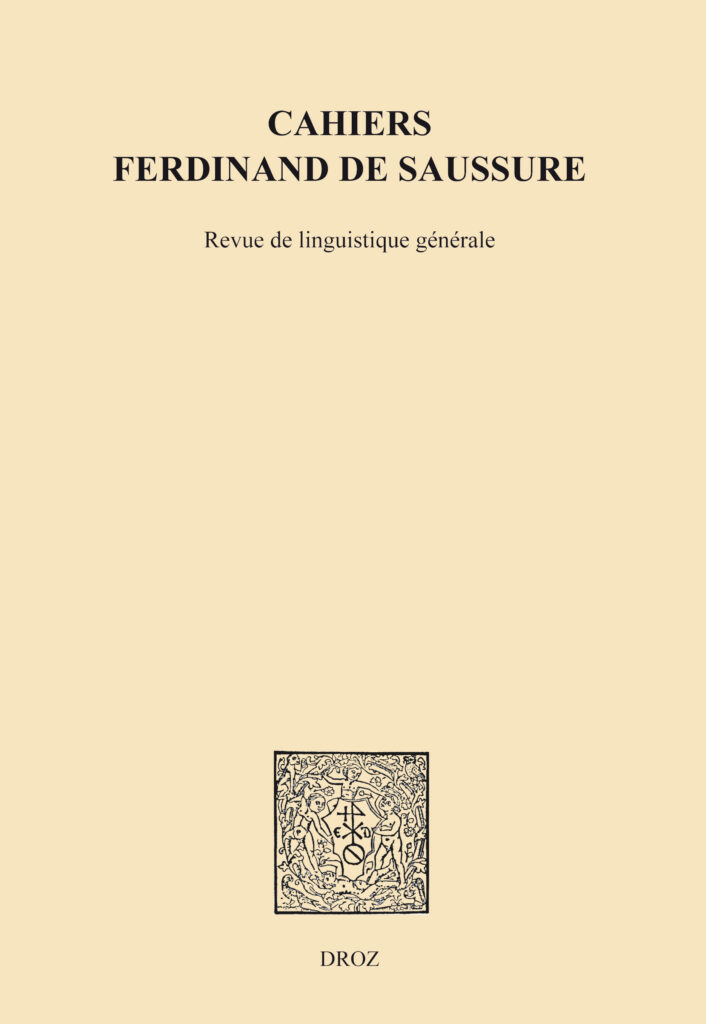
Cahiers Ferdinand de Saussure, volume 77 (2024), édité par Giuseppe D’OTTAVI, Genève, Librairie Droz, 2026, 280 pages, ISSN : 0068-516X, ISBN-13 : 978-2-600-06759-1, € 60,00 Date de première publication : 25 juin 2026 Voir la notice de l’Éditeur. Ce numéro en version numérique : https://revues.droz.org/CFS/issue/view/CFS_77
Abstract: This essay examines the interpretation of Saussure’s thought in the work of Giorgio Agamben, focusing in particular on the works preceding the Homo Sacer series. The comparison of the two authors reveals a tension that can advance contemporary philosophy of language in two ways. On the one hand, Saussure offers more than one reason to be wary of Agamben’s hostility to the notion of “sign”; on the other, Agamben offers a path to overcome the difficulties in Saussure’s approach to the notion of “history”. Keywords: Agamben, Benveniste, History, Infancy, Philosophical anthropology.
Adriano BERTOLLINI (Università degli Studi di Palermo), Agamben reader of Saussure. II. The Benveniste case, p. 27-42
Abstract: This essay investigates how Giorgio Agamben interprets Saussure’s thought in connection with Benveniste. Although he credits Saussure with great importance in the history of Western philosophy, the Italian philosopher tends to read the work of the author of the Cours in the light of Benveniste’s studies, especially the article entitled “Sémiologie de la langue” (1969). In what follows, we will try to point out the advantages, but above all the problems of such a juxtaposition, which does not seem to do full justice to the thought of the Swiss linguist. Keywords: Agamben, Benveniste, “Note sur le discours”, Glossolalia, “Sémiologie de la langue”.
Claudia STANCATI (Università della Calabria), Le sens de la syntaxe entre linguistique et philosophie des sciences. Une reconstruction croisée entre l’École de Genève et Cournot, p. 43-61
Abstract: The linguists of the Geneva School extend the notion of syntax to the affective and the imaginative, which involves a redefinition of the relationship between language and thought. From this redefinition stems their attention to scientific language and notations. In fact, although they are not the primary focus of their investigations, they serve as points of comparison. This paper outlines a backward itinerary through the linguistics and philosophy of science up to Cournot. The aim is not to identify the precursors of the Geneva School but rather to show the intertwining of the epistemology of linguistics and that of other sciences. It deals with complex interconnections which refer to the repositioning of syntax within linguistics and logic. Keywords: Syntax, Linguistics, Logic, Philosophy of sciences, Language and thought, Geneva School.
III Résumés de thèse
Francesco PARISI (Università di Napoli “L’Orientale”), Le Cours de linguistique générale de F. de Saussure et Matière et mémoire de H. Bergson : analyse comparative de lexèmes communs. Lexique, usages terminologiques et implications théoriques, p. 65-78
Abstract: This research aims to compare the philosophical theses of H. Bergson with the linguistic theses of F. de Saussure, starting from an analysis of their respective terminological systems. In particular, the study considers the use of shared lexemes appearing in Matière et mémoire (1896) and in Cours de linguistique générale (1916). The analysis sheds new light on their positions within the context of the debate on the relationship between mind and language. Moreover, following the same methodology, an examination of certain textual occurrences in Saussure’s notes (2002) demonstrates to what extent the function of the langue involves the articulation of both speech and thought. This article presents a summary of the doctoral thesis defended by the author in 2013. Keywords: Henri Bergson, CLG, Terminology, Mind, Language.
IV Hommage
Francesca M. DOVETTO (Università degli Studi di Napoli “Federico II”), Présentation de Dalla ‘langue’ alla ‘parole’: verba manent. Scritti di Federico Albano Leoni (Napoli, 2021), p. 81-86
Abstract: This article presents Verba manent, a volume compiled by Federico Albano Leoni’s former students in honor of his eightieth birthday. The book showcases his multifaceted scientific contributions across Germanic philology, historical linguistics, phonetics, phonology, and the philosophy of language. Rooted in Saussurean thought, Albano Leoni’s work challenges traditional linguistics by prioritizing the listener’s role and the semantic dimension of parole over abstract systems. His theoretical framework emphasizes the radical imperfection of linguistic action, the embodied nature of language, and the social character of linguistic practices. The volume includes an interview, thematic sections, and a comprehensive bibliography of his scholarly production. Keywords: Federico Albano Leoni, Phonetics and phonology, Saussurean linguistics, Spoken Italian corpora, Philosophy of language.
Giovanna MAROTTA (Università di Pisa), La phonétique selon Federico Albano Leoni, p. 87-98
Abstract: This overview of Federico Albano Leoni’s scientific work focuses particularly on his studies in phonetics and prosody, highlighting the most original and innovative aspects of his research. It also underscores his pivotal role in promoting acoustic phonetics in Italy since the 1980s, closely linked to the research projects he led to develop extensive corpora of spoken Italian. His critical stance on the concept of phoneme, along with his distinctive views on theoretical phonology, is examined through both his own arguments and alternative perspectives. Keywords: Phonetics, Phoneme, Syllable, Corpora, Prosody.
Diego POLI (Università di Macerata), Federico Albano Leoni et le domaine du sens, p. 99-111
Abstract: This article explores Federico Albano Leoni’s contributions to linguistic research, with particular emphasis on spontaneous speech and acoustic analysis. Drawing on experimental work with spoken corpora, Albano Leoni develops insights into perception and recognition in communication, highlighting the central role of the syllable alongside prosodic features. His writings engage with theoretical traditions, including Bühler’s language theory and Gestalt principles, while maintaining close attention to empirical data. The discussion addresses broader questions concerning the relationship between written and spoken language, the listener’s interpretive activity, and the importance of interdisciplinary perspectives in understanding how meaning emerges in actual linguistic exchanges. Keywords: Phonetics, Phonology, Syllable, Speech perception, Linguistic empiricism.
V Centenaire du Recueil
Georges-Jean PINAULT (École Pratique des Hautes Études, Paris), Le Recueil des publications scientifiques dans l’histoire de la linguistique indo-européenne, p. 115-139
Abstract: The centerpiece of the Recueil is undoubtedly the Mémoire, the first book (1878) and almost the only one (apart from his doctoral thesis, 1881), published by F. de Saussure himself during his lifetime. This masterwork laid the groundwork for understanding the structure of the Proto-Indo-European language, while providing numerous specific results concerning its phonological and morphological system. Besides, the Recueil contains several relatively short contributions addressing specific problems of Indo-European phonology, morphology and etymology. Taken as a whole, the Recueil continues to inspire discussion and debate to the present day. Keywords: Apophony, Derivation, Etymology, Indo-European, Laryngeals, Morphology, Phonology, Reconstruction, Root, Structure.
Marie-José BÉGUELIN (Université de Neuchâtel / ARLLFB), La place du Mémoire, p. 141-166
Abstract: Almost 150 years after its publication, and a century after its inclusion in the Recueil des publications scientifiques de Ferdinand de Saussure (1922), the article aims to (re)assess the scientific scope of Saussure’s Mémoire sur le système primitif des voyelles dans les langues indo-européennes (1879 [1878]), as well as its theoretical impact, from three different perspectives. Following a brief overview of its content and historical setting, the Mémoire is considered, firstly, as a part of the Recueil itself, among Saussure’s ante mortem publications. Secondly, it is approached as a landmark work in the comparative grammar of Indo-European languages, whose theses, after a bumpy ride, have ended up being established as certainties, while its methodological achievements still await a precise assessment. Finally, it is regarded as an intellectual and human experience that determined the rest of Saussure’s career, nourishing his views on general linguistics. Keywords: Analogy, Apophony, Classification of roots, Indo-European, Laryngeals, Morphology, Semiology.
Maria Patrizia BOLOGNA, Le grec ancien dans le Recueil saussurien, p. 167-181
Abstract: The Recueil des publications scientifiques de Ferdinand de Saussure contains a series of papers devoted specifically to Ancient Greek, addressing both the etymology of proper names and common lexical items, as well as phonetic issues. This paper examines these works, highlighting the image of Saussure as a Hellenist that emerges from them, while considering the continuity – or lack thereof – of his proposals in subsequent scholarship. It also demonstrates how these studies constitute one of the key testimonies to Saussure’s intellectual trajectory, from the analysis of linguistic facts to reflection on the nature of language itself. Keywords: Ancient Greek, Etymology, Onomastics, Common lexicon, Phonetics.
John E. JOSEPH (University of Edinburgh), Noblesse oblige : The Publications of Ferdinand de Saussure, 1901-1912, p. 183-200
Abstract: Ferdinand de Saussure (1857-1913) notoriously published very little in the 20th century, though he was just 43 when it began in 1901. What he did put before the public in these years, beyond his teaching, was in every case called forth by some social or personal duty, either to the community of Geneva academics to which he belonged, or to individual scholars who had played some part in his career. This article surveys his publications over these years. Keywords: Place names, Germanic legends, sound symbolism, Joseph Loth, Louis Havet, Vilhelm Thomsen.
Daniele GAMBARARA (Università della Calabria), Pour un supplément au Recueil saussurien, p. 201-220
Abstract: This article presents a commented bibliography of the 25 works published during Ferdinand de Saussure’s lifetime that are not included in the 1922 Recueil (and a posthumous one in the Appendix, § 3). The works are divided into two lists: one for articles sent to press directly by Saussure (§ 1), and another for texts sent to fellow researchers (§ 2). Each entry is documented with its first identification in Saussurean scholarship, related studies or editions, and references to the most recent bibliographies and Joseph’s 2012 monograph. Many of these works are accessible online. Together, they offer a richer view of Saussure’s scientific activities, revealing aspects of his linguistic research that go beyond the 1922 collection. Keywords: Works published by F. de Saussure, History of linguistics, Bibliography, Scientific correspondence.
VI Documents
Estanislao SOFÍA (CONICET – Universidad de Buenos Aires), Pierre SWIGGERS (KU Leuven), Holger Pedersen, Charles Bally et le Cours de linguistique générale, p. 223-237
Abstract: After the publication of the Cours de linguistique générale in 1916, Charles Bally devoted considerable effort to promoting the work across Europe, notably by soliciting reviews from foreign colleagues. One of the linguists he contacted was the Danish scholar Holger Pedersen, a near contemporary of Saussure and a leading figure in comparative linguistics. Pedersen responded favorably to Bally’s invitation but ultimately did not publish a review – a regrettable fact, given that the Danish linguist, an admirer of the Mémoire, held strong views regarding the orientation of linguistic studies. Keywords: Division(s) of linguistics, Language and speech, General linguistics, Comparative grammar, Charles Bally, Holger Pedersen.
VII In memoriam
Irène FENOGLIO, Jean-Claude Coquet (1928-2023), p. 241-243
Types d’unités et procédures de segmentation, sous la direction de Marie-José Béguelin, Gilles Corminboeuf, Florence Lefeuvre, Limoges, Lambert-Lucas, 2020 (L. Möschler), p. 247-250
Francesco La Mantia, Pour se faire langage. Lexique élémentaire de la Théorie des Opérations Prédicatives et Énonciatives d’Antoine Culioli, Louvain-la-Neuve, Academia-L’Harmattan, 2020 (A. Bondì), p. 251-254
Aurélien Sauvageot (†), Un linguiste dans son siècle. Mémoires, 1897‒1954, Paris, L’Harmattan & Association pour le développement des études finno-ougriennes 2020 (P. Swiggers), p. 255-259
Émile Benveniste. Le sorgenti segrete di un linguista poliedrico, a cura di Giovanni Manetti e Federica Venier, Pisa, Edizioni ETS, 2021 (S. Frigeni), p. 260-263
Le thème perceptif et expressif. Entre linguistique, sémiotique et philosophie, sous la direction de Antonino Bondì et David Piotrowski, Paris, CNRS Éditions, 2022 (E. Fadda), p. 264-266
With Saussure, Beyond Saussure: Between Linguistics and Philosophy of Language, edited by Marina De Palo and Stefano Gensini, Münster, Nodus Publikationen, 2022 (J.E. Joseph), p. 267-270
[…]
In De l’idéal dans l’art (1867), Taine had already introduced and developed the concept of [357] valeur as a feature that is characteristic of an epoch in the history of art; the historian must note the changes of value between epochs, for such changes create new systems.4 In Ferdinand de Saussure’s Cours de linguistique générale (1916) valeur also plays an important role. English sheep and French mouton can have the same significations, but not the same valeur. Each word has its place in the system that determines its value. 5
In the chapter on “La valeur linguistique,” Saussure also made a statement that has now been cited so often that it has become a commonplace, like a key to his linguistic thought: “Language can also be compared to a sheet of paper: thought is the recto and sound the verso; we cannot cut one side without also cutting the other. So also in language, sound cannot be isolated from thought, or thought from sound.”6 The linguistic sign is a psychic entity with two surfaces, intimately related and recalling one another. Everyone knows that he called them the signifiant and the signifié. This principle and the striking metaphor that illustrates it are also in Taine’s great work.
[…]
Near the end of the first volume of De l’intelligence Taine came to the crucial point in his argument: how do physical and mental events connect? Many philosophers, he said, have argued that these two kinds of events are heterogeneous; they say that the image is internal while the sensation comes from the outside. Since they perpetually diverge, no common point can be found. Taine answers that they are not different events, but a single event known under two different [358] aspects. This explanation satisfies Taine because it does not rely on any imaginary or unknown third element. He concludes that the two kinds of separate events previously postulated are always of necessity bound together, “for as soon as they are reduced to a single event with two aspects, it is clear that they are like the verso and recto of a surface, and that the presence or absence of one incontrovertibly entails that of the other. We have a single event with two faces, one mental, the other physical, one accessible to the understanding, the other to the senses.” 10
The sheet is his metaphor for the “central event” that “communicates its character to the rest.”
But what, he asks, “is the value of each of the two points of view?” That of the understanding (conscience) is always direct, the image of the sensation within us, for Taine materially located in the constitution of the brain. But the other aspect, that of external perception, is indirect, for it never gives knowledge of the physical object itself: “In itself this physical and sensible object remains altogether unknown; we know nothing about it except the group of sensations it provokes in us… that is to say their constant effects on us, their fixed accompaniments, their signs, nothing but signs, signs and tokens of things unknown.” Taine continued: “Thus there is a great difference between the two points of view. By the understanding I attain the fact in itself; by sense I attain only a sign. A sign of what? What is it that is always accompanied, denoted, signified by the internal motion of the nervous centers? …it is the sensation, the image, the internal mental event.” Sharing Saussure’s well-known fondness for dichotomies, Taine has analyzed the sign into the purely mental signifié and the invariably linked signifiant (a term Taine does not use), which, coming from the outside, to us appears physical. We now understand, “why the mental event, being single, must appear double to us; the sign and the event signified are two things that can neither become one nor be separated, and their distinction is as necessary as their connection. But in regard to this distinction and this connection, the advantage is entirely on the side of the mental event; it alone exists. The physical event is merely the manner in which it affects or could affect our senses.”11 It is evident that Taine’s analysis contains all the elements of Saussure’s doctrine of signs. For both Taine and Saussure the full range of signs included more than words, but both concentrated on words as the chief kind of mental images. As for Taine, Saussure’s “images acoustiques” are only instruments of thought, but in themselves they are nothing until they become “des entités linguistiques” by being joined to concepts. At one point Saussure says that this “unité à deux [359] faces” has been compared to “the unity of the human person, composed of body and soul,”—though he prefers to think of it as the union of hydrogen and oxygen in the chemical constitution of water.12 We may find this analogy unhappy, but it still shows that Saussure understood what Taine was talking about and that he sought a scientific image that falls into line with Taine’s orientation. This preference for scientific illustrations —for crystallization, glaciers, moraines, geological layers, mineralogy, anatomy, spiral shapes, physiology, and “les formules de la science”—is a constant reminder that Saussure was working within the conceptual milieu of Taine’s thought. When Saussure said that “without the aid of signs, we would be unable to distinguish two ideas in a clear and certain manner,” that “there are no pre-established ideas, and nothing is distinct before the appearance of language,” he was following Taine’s argument—and as Taine acknowledged, Condillac’s. For Taine, the joining of sound and concept formed what Saussure called “a complex unity, physiological and mental.”13 The two features I have dealt with bring Taine and Saussure so closely together that it would be implausible to argue that the young French-speaking Genevan did not know Taine’s work.↓
4↑ Philosophie de l’art, 13th ed. in two vols. (Paris: Hachette, 1909) was after 1882 the
general title of the work that comprised the five series of lectures, previously published separately, that Taine gave at the École des Beaux-Arts, beginning in 1865. De l’idéal dans l’art is here in vol. II, 221-346. See passim, but, e.g., p. 234: “In the world of imagination as well as in the world of reality there are different levels because there are different values,” and p. 268: “I am speaking of historical epochs. The system of ideas and sentiments that filled a human head in the time of Louis XIV was altogether different from what it is today.” 5↑ Saussure, Cours de linguistique générale, ed. Tullio de Mauro (Paris: Payot, 1973), pp. 154-169 “La valeur linguistique.” 160: “Forming part of a system, it is endowed not only with a signification but also with a value, and that is something quite different.” P. 157: “Values actually remain entirely relative… the arbitrariness of the sign makes us understand better why the social fact alone can create a linguistic system. The collectivity is necessary for the creation of values.” Since this is the text that has made Saussure’s thought known and influential, the “vulgate” text so to speak (hereafter referred to as Cours), this is the text I have used unless otherwise noted. In spite of de Mauro’s useful and extensive exploration of Saussure’s intellectual background, he never mentions Taine; the same is true for the rest of the literature, now very large, on Saussure. I have also used Rudolf Engler’s variorum, “édition critique” of the Cours (Vol. I, fasc. 1-3, Wiesbaden: Harrassowitz, 1967-1968; vol. II, fasc. 4, 1974). This immense and byzantine edition (hereafter referred to as Engler, ed., Cours) offers a wealth of evidence that supports my argument, but too extensive and detailed to present here. 6↑ Cours, p. 157. Cf. p. 99: “Thus the linguistic sign is a psychic entity with two sides.”
[…] 10↑ De l’intelligence, I, 329. This passage was first published in “Les vibrations cérébrales et la pensée’’ in Revue philosophique 3 (Jan. 1877), p. 7 (where the entire article covers pp. 1-9); it was then included in De l’intelligence in the 3rd (1878) and following editions. 11↑ De l’intelligence, I, 329-331. 12↑ Cours, p. 145. 13↑ Cours, p. 155, 24. Cf. Engler, ed., Cours, I, 16 (in G 3.44a, 89): “It would have been better if linguists had found their ideas elsewhere, perhaps in the natural sciences. Perhaps the scientific tendency would have dawned sooner.”
Extrait de l’article, p. 356-359
Cette dernière phrase — tirée de l’un des essais saussuriens les plus connus de Hans Aarsleff (1925–2026) — referme tout un réseau serré de correspondances textuelles entre De l’intelligence et le Cours, et illustre bien son style argumentatif : une érudition minutieuse mise au service d’une affirmation tranchée, présentée comme inéluctable. Le travail d’Aarsleff a eu le mérite de remettre en question, comme c’est le cas ici, la notion même d’« influence » dans l’histoire des idées linguistiques — suspendue, comme toujours, entre l’évidence de la donnée philologique, la réticence de la donnée archivistique et la conjecture de la donnée biographique. C’est précisément sur ce terrain que, à partir de 2003, puis lors d’un échange public dans les pages du Times Literary Supplement (John E. Joseph, «Root and Branch: Pictet’s Role in the Crystallization of Saussure’s Thought», n. 5258, 9 janvier 2004, p. 12-13 ; Hans Aarsleff, «Duality the Key: Saussure’s Debt to Taine in Conceiving « The Double Essence of Language »», n. 5290, 20 août 2004, p. 12-13 ; accès institutionnel, via Gale TLS Historical Archive), a été proposée, pour les mêmes idées, une généalogie alternative. Que la dette précise envers Taine soit démontrée ou seulement suggérée, la communauté des saussuriens continuera d’en débattre ; mais c’est bien dans cette capacité à susciter un désaccord fécond — substituant au mythe du fondateur la reconstitution d’une généalogie longue, faite d’étapes provisoires — que se mesure la marque d’un chercheur qui aura vraiment compté.
Une bibliographie des écrits de Hans Aarsleff se trouve dans «Language in Intellectual History: The Work of Hans Aarsleff», numéro spécial de History of European Ideas 42/6 (2016), p. 852–854 (accès libre).
The amazing analogy between Cuvier’s and Saussure’s approaches to, respectively, paleontology and linguistics has been pointed out by Guy Jucquois. Cuvier (Jucquois wrote) was familiar to Saussure’s intellectual environment, which included so many distinguished naturalists.30 But a more analytic demonstration can be provided, focusing on Adolphe Pictet, a polymath from Geneva who was very close to the Saussure family. Both the title and the subtitle of Pictet’s book are telling: Les origines indo-européennes ou les Aryas primitifs: Essai de paléontologie linguistique (1859–63).31 Pictet’s contemporaries did not miss the Cuvierian overtones of a “linguistics paleontology” that tried to use words as fossils, aiming to resurrect the environment—natural, cultural and social—in which the original Indo-European population, the Aryans, lived and worked.32 Saussure, who was prodigiously precocious, read Pictet’s book when he was not yet fourteen. Deeply impressed, the young boy wrote an essay on Indo-European vocalism that he submitted to Pictet. Retrospectively, Saussure dismissed his early attempt as “childish.”33 But the three articles dedicated to the second edition of Pictet’s book, which Saussure published in the Journal de Genève in 1878 (he was then twenty-three), deserve to be taken seriously. They are usually ignored by the Saussure scholarship, probably embarrassed by the protoracist aura surrounding Pictet’s figure. Needless to say, the word race had multiple meanings in the nineteenth century, exemplified by the distinction between linguistic and anthropological races put forward by Ernest Renan.34 But the identity between population and language was at the very heart of Pictet’s project. Relying upon the old antiquarian metaphor, he mentioned the possibility of using fossil words as medals, as a clue pointing to a lost external reality—thus subscribing to the core of Pictet’s project. In his mature age, Saussure rejected all of this, starting from the identification between ethnic and linguistic phenomena. To define the relationship between them, he advanced the distantiating neologism “ethnisme” in his Cours de linguistique générale.35 But the Cours, starting from the notion of the arbitrariness of the sign, focused on language and its complexities. This trajectory is well known, but it includes an episode that many Saussure scholars regarded as disturbing. I refer to the draft of a letter written in Saussure’s hand, between November and December 1894, at the beginning of the Dreyfus affair, and addressed to Edouard Drumond, the director of the anti-Semitic journal La libre parole. The draft (apparently the related letter was never published) had an explicit anti-Semitic tone, qualifying the Jews as “parasites” and “usurers,” and referring to a specific passage of Drumont’s best seller La France juive (1886) (quoted in S, p. 415). It has been suggested (with no basis whatsoever) that Saussure wrote the draft under his father’s dictation (his father was a notorious racist). One might assume that Saussure was at that time still under the impact of Pictet’s intellectual commitment to “the ancient Aryans . . . [,] our first ancestors.”36 Four years later, in 1898, Saussure declared himself “Dreyfusiste convaincu” (a committed partisan of Dreyfus) (quoted in S, p. 416). But the anti-Semitic draft included a piece of information—Saussure’s familiarity with Drumont’s La france juive—which may be relevant for the history of linguistics. It has been noted that the dictum usually associated with Saussure—that language is a system in which everything is connected—does not appear in Saussure’s writings, either published or unpublished.37 It is actually a misreading of Antoine Meillet’s “phonétiques de chaque idiome forment un système où tout se tient,” which presumably echoes the lectures delivered by his teacher, Saussure, in 1881–91.38 At that time, as it has been noted, the expression “un système où tout se tient” was already a commonplace.39 But it may be interesting to note that the same expression can be found in two books by Drumont: La fin d’un monde: étude psychologique et sociale (1889) and La dernière bataille: Nouvelle étude psychologique et sociale (1890). In both cases, the context is anti-Semitic, although the latter passage corrects the former: “The Jews . . . have built up a system in which everything is connected [où tout se tient], that embraces the whole country”;40 “Unfortunately for the Jews, society is a complex organism in which everything is connected [où tout se tient].”41 Saussure may have picked up this formula, reworking it in a completely different—purely linguistic—context. But behind Saussure’s emphasis on synchrony one can detect a distant, distinct echo of Cuvier’s static morphology, punctuated by innumerable revolutions.
30↑ Guy Jucquois, “L’imaginaire en linguistique,” in Bono homini donum: Essays in Historical Linguistics, in Memory of J. Alexander Kerns, ed. Yoël L. Arbeitsmann and Allan R. Bomhard (Philadelphia, 1981), pp. 159–78, esp. p. 165. The importance of Cuvier’s work for comparative linguistics has been pointed out, in general terms, by Winfred P. Lehmann, Theoretical Bases of Indo-European Linguistics (New York 1993), p. 297. Cassirer regarded Cuvier as a forerunner of linguistic structuralism. For Cassirer’s quotation of Antoine Meillet’s remark on language as a system “où tout se tient,” see Cassirer, “Structuralism in Modern Linguistics,” pp. 107–108. 31↑ See Maurice Olender, Les Langues du paradis: Aryens et Sémites: un couple providential (Paris 1989), pp. 127–41. The list of books owned by Saussure, today at the Bibliothèque Universitaire de Genève, includes several works by Pictet, including two editions of Origines; see Daniele Gambarara, “La bibliothèque de Ferdinand de Saussure,” Bulletin du Musée d’Art et d’Histoire 20 (1976): 355. 32↑ See the letter addressed by the zoologist Jean Louis Armand de Quatrefages de Bréau to Pictet in Olender, Les langues du Paradis, p. 134 n. 17. 33↑ Quoted in John E. Joseph, Saussure (New York, 2012), p. 153; hereafter abbreviated S. 34↑ See Ernest Renan, Histoire générale et système comparé des langues Sémitiques (Paris, 1855). 35↑ Ferdinand de Saussure, Cours de linguistique générale (Paris, 1916). 36↑ Adolphe Pictet, Les origines indo-européennes, ou les Aryas Primitifs: Essai de paléontologie Linguistique (Paris, 1877), p. 380. 37↑ See E. F. K. Koerner, “Noch einmal on the History of Language as a ‘Système où tout se tient,” Cahiers Ferdinand Saussure 51 (1998): 203. 38↑ Antoine Meillet, “Les lois de langage,” Revue internationale de sociologie 1 (July–Aug. 1893), p. 318. 39↑ See Koerner, “Noch einmal on the History of Language as a ‘Système où tout se tient.’” 40↑ Edward Drumont, La fin d’un monde: étude psychologique et sociale (Paris, 1889), p. 79. 41↑ Drumont, La dernière bataille: Nouvelle étude psychologique et sociale (Paris, 1890), p. xvi.
Extrait de l’article, § 10, pp. 389-391
La confrontation de Carlo Ginzburg (1939-2026) avec Saussure ne commence pas avec cet article. Déjà dans « Spie. Radici di un paradigma indiziario » (1979 ; paru en fr. dans Le Débat 6/6, 1980, pp. 3-44, texte complet disponible sur cairn.info) Saussure est une absence parlante : la linguistique y figure comme la « notable exception » contre laquelle Ginzburg construit, par contraste, la généalogie du paradigme indiciaire. Toutes les oppositions qui structurent l’essai — individuel contre général, diachronique contre synchronique, signe motivé contre signe arbitraire — dessinent à contre-jour la silhouette théorique du modèle saussurien. Saussure n’y est jamais nommé, mais il est partout. « Medals and Shells » serait alors le moment où, quarante ans plus tard, Ginzburg finit par nommer le fantôme — et, du même geste, le soumet à sa propre méthode.
Aujourd’hui, le Cours de linguistique générale fête ses 110 ans.
Comme l’a découvert Estanislao Sofía (Cahiers Ferdinand de Saussure 69, 2016), le 19 mai 1916, l’éditeur Payot écrivait à Charles Bally (BGE. Ms. fr. 5011, f. 161) :
Monsieur, le « Cours de Linguistique générale » paraît aujourd’hui en librairie. Il sera dès demain samedi entre les mains de tous les libraires genevois. Vous pouvez donc leur adresser vos étudiants.
Pour célébrer dûment cet anniversaire, la Task Force du site du Cercle a mis le Cours dans une petite centrifugeuse numérique d’où est né le Concordancier Général, un outil qui permet une exploration systématique des paroles du Cours : concordances et KWIC (Key Word in Context), statistiques (profil de mot, comparaison de mots, heatmap des sections), index automatique et hapax saussuriens.
Désormais accessible depuis la rubrique Ressources électroniques de notre site, le Concordancier Général repose aujourd’hui en grande partie sur un traitement automatique du texte. Le travail de balisage en cours permettra de l’enrichir progressivement d’index analytiques (noms propres, lieux, œuvres, termes-clé…) et d’autres diableries modernes.
N’hésitez pas à signaler à la Task Force les éventuelles anomalies (erreurs de texte, erreurs d’indexation, passages mal découpés). Le Concordancier Général est imparfait, mais d’ores et déjà opérationnel : vous pouvez donc lui adresser vos étudiants !
John E. Joseph (ed.), The Bloomsbury Handbook of Saussure, New York / London, Bloomsbury Academic, 2025, 416 p., ISBN 978-1-3503-7978-7, 28 bw ill., 175 $ Notice de l’Éditeur, avec table des matières. Ce livre est disponible en ligne sur Bloomsbury Collections (abonnement requis)
To call Ferdinand de Saussure (1857-1913) the father of modern linguistics, and one of the two parents of semiotics, is obviously metaphorical, and while founder may seem less so, in a literal sense Saussure never founded anything. His contributions to modern semiotics amounted, in its formative period, to a few pages – incredibly rich pages, but sparse. If modern linguistics is Saussurean, he never saw it practised, apart from his own lectures and the masses of manuscripts he left unpublished, with small hints of it in some of his publications. The latter do not include that foundational document of modern linguistics, the Cours de linguistique générale (Course in General Linguistics, abbreviated henceforth as CLG), which, although it bears his name as its author, he did not compose, let alone publish. The story is well-known of how his colleagues Charles Bally (1865–1947) and Albert Sechehaye (1870–1946) compiled students’ notes of his lectures, along with notes of his own, wrote the book and published it in 1916, three years after his death. He died forgotten by most linguists, despite having once had considerable renown on account of a book which he wrote as a student, when by rights he ought to have been focusing on getting his degree. The Mémoire sur le système primitif des voyelles dans les langues indo-européennes (Memoir on the original system of vowels in the Indo-European languages, 1879) overturned the eld he was studying, and promised a great career – which he then managed to sabotage at almost every opportunity. He recognized this and regretted it, and he died with no expectation of his work being appreciated. That it would not only be remembered but have such a spectacular afterlife, with generations of scholars devoted to its exegesis, is little short of a miracle. This was a man who never believed the science was settled. On the contrary, he thought that very little in the science of language could be accepted at face value. Where the boundaries lay between various basic terms related to language, linguists had not bothered to settle, though some had made an initial effort. Linguists imagined language as starting from a set of sounds, in the way that alphabetic writing was invented to capture, and these sounds then combine to form words, which in turn combine to form sentences. Saussure began by questioning whether sounds as such really matter at all. Rather, what matters is the system they form – a system in which the differences between elements are what count, rather than the sound elements in their own right.
Extrait de la préface par J. E. Joseph, p. XIV-XV.
L’ouvrage sera présenté par John Joseph à l’occasion de l’AG 2025 du Cercle, le 20 septembre à l’Université de Lausanne, salle CD106 du Châteaude Dorigny.
Nous utilisons des cookies pour vous garantir la meilleure expérience sur notre site web. Si vous continuez à utiliser ce site, nous supposerons que vous en êtes satisfait.