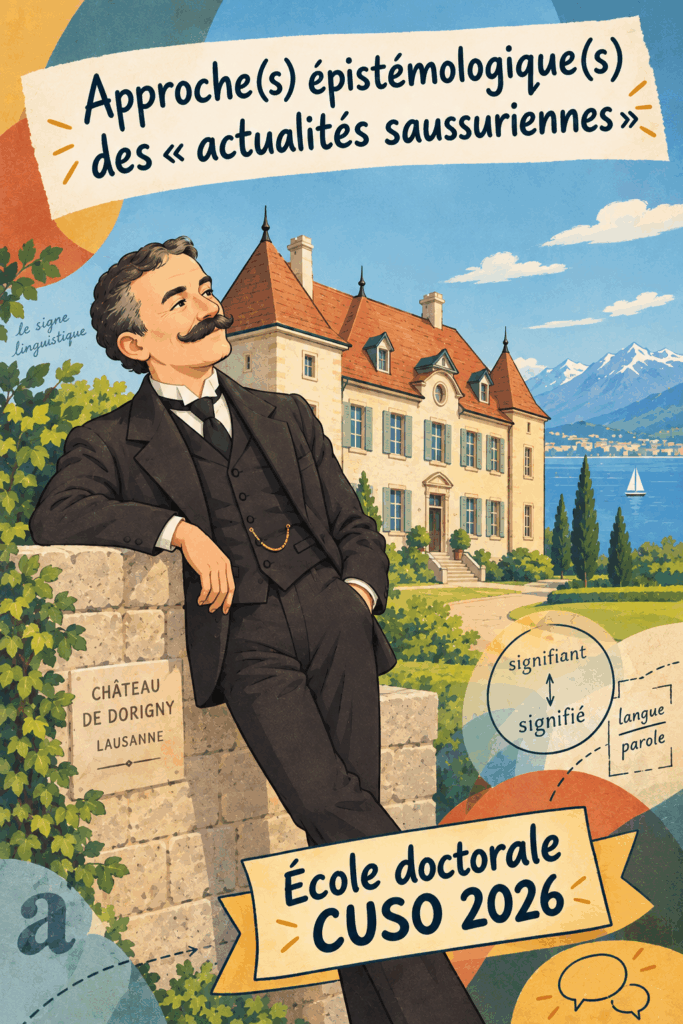
L’école doctorale CUSO de cette année s’apprête à prendre la route. Rendez-vous lundi 5 et mardi 6 octobre, à Lausanne, pour deux intenses journées vouées à regarder de plus près ce qui, dans l’héritage intellectuel de Saussure, demeure bien vivant et continue de faire travailler la linguistique d’aujourd’hui.
🗓️ Dates et heure : lundi 5 et mardi 6 octobre 2026 📍 Lieu : Château de Dorigny, CD106, Campus de l’Université de Lausanne (Unil) 🏛️ Organisateurs : Prof. Ekaterina Velmezova (Université de Lausanne), Prof. Ecaterina Bulea Bronckart (Université de Genève), PD Dr. Anne-Gaëlle Toutain (Université de Berne), Daria Fargues (Université de Lausanne) 🎤 Intervenants : Prof. Emanuele Fadda (Université de Calabre), Prof. Ecaterina Bulea Bronckart (Université de Genève) en remplacement de la Prof. Claire Forel (Université de Genève) 🙋 En présentiel 🔗 Programme et résumés ℹ️ Informations
Dans l’histoire de la linguistique, Ferdinand de Saussure reste un classique incontestable, connu comme un savant qui a eu une grande influence sur le développement des sciences du langage au XXe siècle. Si ce fait est aujourd’hui bien connu et commenté en détail par les historiens de la linguistique, on accorde beaucoup moins d’attention au caractère actuel, pour la linguistique d’aujourd’hui, de l’héritage intellectuel saussurien.
L’objectif de l’école doctorale sera de combler, en partie, cette lacune. À cet égard, les doctorant-e-s seront invité-e-s à aborder les domaines suivants :
Ferdinand de Saussure et la sémiotique moderne
Ferdinand de Saussure et les sciences de l’éducation (pédagogie, didactique, formation des enseignants) aujourd’hui
Ferdinand de Saussure et l’histoire des sciences du langage à l’heure actuelle.
Une attention particulière sera portée au travail sur des sources qui sont aujourd’hui beaucoup moins connues que le Cours de linguistique générale, y compris des documents d’archives.
[…]
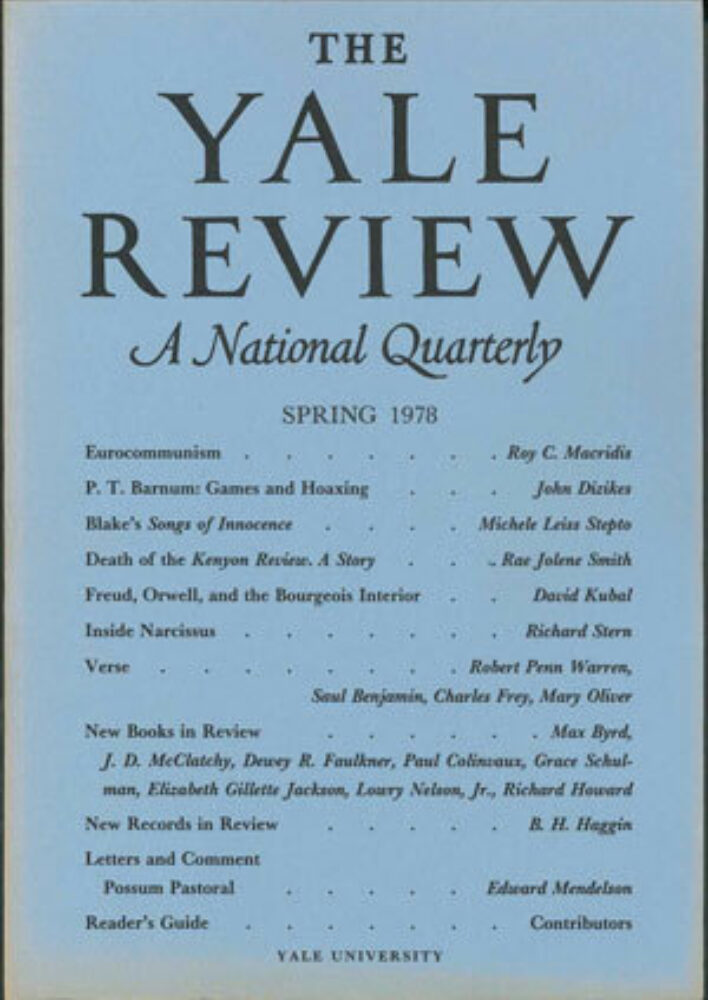
In De l’idéal dans l’art (1867), Taine had already introduced and developed the concept of [357] valeur as a feature that is characteristic of an epoch in the history of art; the historian must note the changes of value between epochs, for such changes create new systems.4 In Ferdinand de Saussure’s Cours de linguistique générale (1916) valeur also plays an important role. English sheep and French mouton can have the same significations, but not the same valeur. Each word has its place in the system that determines its value. 5
In the chapter on “La valeur linguistique,” Saussure also made a statement that has now been cited so often that it has become a commonplace, like a key to his linguistic thought: “Language can also be compared to a sheet of paper: thought is the recto and sound the verso; we cannot cut one side without also cutting the other. So also in language, sound cannot be isolated from thought, or thought from sound.”6 The linguistic sign is a psychic entity with two surfaces, intimately related and recalling one another. Everyone knows that he called them the signifiant and the signifié. This principle and the striking metaphor that illustrates it are also in Taine’s great work.
[…]
Near the end of the first volume of De l’intelligence Taine came to the crucial point in his argument: how do physical and mental events connect? Many philosophers, he said, have argued that these two kinds of events are heterogeneous; they say that the image is internal while the sensation comes from the outside. Since they perpetually diverge, no common point can be found. Taine answers that they are not different events, but a single event known under two different [358] aspects. This explanation satisfies Taine because it does not rely on any imaginary or unknown third element. He concludes that the two kinds of separate events previously postulated are always of necessity bound together, “for as soon as they are reduced to a single event with two aspects, it is clear that they are like the verso and recto of a surface, and that the presence or absence of one incontrovertibly entails that of the other. We have a single event with two faces, one mental, the other physical, one accessible to the understanding, the other to the senses.” 10
The sheet is his metaphor for the “central event” that “communicates its character to the rest.”
But what, he asks, “is the value of each of the two points of view?” That of the understanding (conscience) is always direct, the image of the sensation within us, for Taine materially located in the constitution of the brain. But the other aspect, that of external perception, is indirect, for it never gives knowledge of the physical object itself: “In itself this physical and sensible object remains altogether unknown; we know nothing about it except the group of sensations it provokes in us… that is to say their constant effects on us, their fixed accompaniments, their signs, nothing but signs, signs and tokens of things unknown.” Taine continued: “Thus there is a great difference between the two points of view. By the understanding I attain the fact in itself; by sense I attain only a sign. A sign of what? What is it that is always accompanied, denoted, signified by the internal motion of the nervous centers? …it is the sensation, the image, the internal mental event.” Sharing Saussure’s well-known fondness for dichotomies, Taine has analyzed the sign into the purely mental signifié and the invariably linked signifiant (a term Taine does not use), which, coming from the outside, to us appears physical. We now understand, “why the mental event, being single, must appear double to us; the sign and the event signified are two things that can neither become one nor be separated, and their distinction is as necessary as their connection. But in regard to this distinction and this connection, the advantage is entirely on the side of the mental event; it alone exists. The physical event is merely the manner in which it affects or could affect our senses.”11 It is evident that Taine’s analysis contains all the elements of Saussure’s doctrine of signs. For both Taine and Saussure the full range of signs included more than words, but both concentrated on words as the chief kind of mental images. As for Taine, Saussure’s “images acoustiques” are only instruments of thought, but in themselves they are nothing until they become “des entités linguistiques” by being joined to concepts. At one point Saussure says that this “unité à deux [359] faces” has been compared to “the unity of the human person, composed of body and soul,”—though he prefers to think of it as the union of hydrogen and oxygen in the chemical constitution of water.12 We may find this analogy unhappy, but it still shows that Saussure understood what Taine was talking about and that he sought a scientific image that falls into line with Taine’s orientation. This preference for scientific illustrations —for crystallization, glaciers, moraines, geological layers, mineralogy, anatomy, spiral shapes, physiology, and “les formules de la science”—is a constant reminder that Saussure was working within the conceptual milieu of Taine’s thought. When Saussure said that “without the aid of signs, we would be unable to distinguish two ideas in a clear and certain manner,” that “there are no pre-established ideas, and nothing is distinct before the appearance of language,” he was following Taine’s argument—and as Taine acknowledged, Condillac’s. For Taine, the joining of sound and concept formed what Saussure called “a complex unity, physiological and mental.”13 The two features I have dealt with bring Taine and Saussure so closely together that it would be implausible to argue that the young French-speaking Genevan did not know Taine’s work.↓
4↑ Philosophie de l’art, 13th ed. in two vols. (Paris: Hachette, 1909) was after 1882 the
general title of the work that comprised the five series of lectures, previously published separately, that Taine gave at the École des Beaux-Arts, beginning in 1865. De l’idéal dans l’art is here in vol. II, 221-346. See passim, but, e.g., p. 234: “In the world of imagination as well as in the world of reality there are different levels because there are different values,” and p. 268: “I am speaking of historical epochs. The system of ideas and sentiments that filled a human head in the time of Louis XIV was altogether different from what it is today.” 5↑ Saussure, Cours de linguistique générale, ed. Tullio de Mauro (Paris: Payot, 1973), pp. 154-169 “La valeur linguistique.” 160: “Forming part of a system, it is endowed not only with a signification but also with a value, and that is something quite different.” P. 157: “Values actually remain entirely relative… the arbitrariness of the sign makes us understand better why the social fact alone can create a linguistic system. The collectivity is necessary for the creation of values.” Since this is the text that has made Saussure’s thought known and influential, the “vulgate” text so to speak (hereafter referred to as Cours), this is the text I have used unless otherwise noted. In spite of de Mauro’s useful and extensive exploration of Saussure’s intellectual background, he never mentions Taine; the same is true for the rest of the literature, now very large, on Saussure. I have also used Rudolf Engler’s variorum, “édition critique” of the Cours (Vol. I, fasc. 1-3, Wiesbaden: Harrassowitz, 1967-1968; vol. II, fasc. 4, 1974). This immense and byzantine edition (hereafter referred to as Engler, ed., Cours) offers a wealth of evidence that supports my argument, but too extensive and detailed to present here. 6↑ Cours, p. 157. Cf. p. 99: “Thus the linguistic sign is a psychic entity with two sides.”
[…] 10↑ De l’intelligence, I, 329. This passage was first published in “Les vibrations cérébrales et la pensée’’ in Revue philosophique 3 (Jan. 1877), p. 7 (where the entire article covers pp. 1-9); it was then included in De l’intelligence in the 3rd (1878) and following editions. 11↑ De l’intelligence, I, 329-331. 12↑ Cours, p. 145. 13↑ Cours, p. 155, 24. Cf. Engler, ed., Cours, I, 16 (in G 3.44a, 89): “It would have been better if linguists had found their ideas elsewhere, perhaps in the natural sciences. Perhaps the scientific tendency would have dawned sooner.”
Extrait de l’article, p. 356-359
Cette dernière phrase — tirée de l’un des essais saussuriens les plus connus de Hans Aarsleff (1925–2026) — referme tout un réseau serré de correspondances textuelles entre De l’intelligence et le Cours, et illustre bien son style argumentatif : une érudition minutieuse mise au service d’une affirmation tranchée, présentée comme inéluctable. Le travail d’Aarsleff a eu le mérite de remettre en question, comme c’est le cas ici, la notion même d’« influence » dans l’histoire des idées linguistiques — suspendue, comme toujours, entre l’évidence de la donnée philologique, la réticence de la donnée archivistique et la conjecture de la donnée biographique. C’est précisément sur ce terrain que, à partir de 2003, puis lors d’un échange public dans les pages du Times Literary Supplement (John E. Joseph, «Root and Branch: Pictet’s Role in the Crystallization of Saussure’s Thought», n. 5258, 9 janvier 2004, p. 12-13 ; Hans Aarsleff, «Duality the Key: Saussure’s Debt to Taine in Conceiving « The Double Essence of Language »», n. 5290, 20 août 2004, p. 12-13 ; accès institutionnel, via Gale TLS Historical Archive), a été proposée, pour les mêmes idées, une généalogie alternative. Que la dette précise envers Taine soit démontrée ou seulement suggérée, la communauté des saussuriens continuera d’en débattre ; mais c’est bien dans cette capacité à susciter un désaccord fécond — substituant au mythe du fondateur la reconstitution d’une généalogie longue, faite d’étapes provisoires — que se mesure la marque d’un chercheur qui aura vraiment compté.
Une bibliographie des écrits de Hans Aarsleff se trouve dans «Language in Intellectual History: The Work of Hans Aarsleff», numéro spécial de History of European Ideas 42/6 (2016), p. 852–854 (accès libre).
The amazing analogy between Cuvier’s and Saussure’s approaches to, respectively, paleontology and linguistics has been pointed out by Guy Jucquois. Cuvier (Jucquois wrote) was familiar to Saussure’s intellectual environment, which included so many distinguished naturalists.30 But a more analytic demonstration can be provided, focusing on Adolphe Pictet, a polymath from Geneva who was very close to the Saussure family. Both the title and the subtitle of Pictet’s book are telling: Les origines indo-européennes ou les Aryas primitifs: Essai de paléontologie linguistique (1859–63).31 Pictet’s contemporaries did not miss the Cuvierian overtones of a “linguistics paleontology” that tried to use words as fossils, aiming to resurrect the environment—natural, cultural and social—in which the original Indo-European population, the Aryans, lived and worked.32 Saussure, who was prodigiously precocious, read Pictet’s book when he was not yet fourteen. Deeply impressed, the young boy wrote an essay on Indo-European vocalism that he submitted to Pictet. Retrospectively, Saussure dismissed his early attempt as “childish.”33 But the three articles dedicated to the second edition of Pictet’s book, which Saussure published in the Journal de Genève in 1878 (he was then twenty-three), deserve to be taken seriously. They are usually ignored by the Saussure scholarship, probably embarrassed by the protoracist aura surrounding Pictet’s figure. Needless to say, the word race had multiple meanings in the nineteenth century, exemplified by the distinction between linguistic and anthropological races put forward by Ernest Renan.34 But the identity between population and language was at the very heart of Pictet’s project. Relying upon the old antiquarian metaphor, he mentioned the possibility of using fossil words as medals, as a clue pointing to a lost external reality—thus subscribing to the core of Pictet’s project. In his mature age, Saussure rejected all of this, starting from the identification between ethnic and linguistic phenomena. To define the relationship between them, he advanced the distantiating neologism “ethnisme” in his Cours de linguistique générale.35 But the Cours, starting from the notion of the arbitrariness of the sign, focused on language and its complexities. This trajectory is well known, but it includes an episode that many Saussure scholars regarded as disturbing. I refer to the draft of a letter written in Saussure’s hand, between November and December 1894, at the beginning of the Dreyfus affair, and addressed to Edouard Drumond, the director of the anti-Semitic journal La libre parole. The draft (apparently the related letter was never published) had an explicit anti-Semitic tone, qualifying the Jews as “parasites” and “usurers,” and referring to a specific passage of Drumont’s best seller La France juive (1886) (quoted in S, p. 415). It has been suggested (with no basis whatsoever) that Saussure wrote the draft under his father’s dictation (his father was a notorious racist). One might assume that Saussure was at that time still under the impact of Pictet’s intellectual commitment to “the ancient Aryans . . . [,] our first ancestors.”36 Four years later, in 1898, Saussure declared himself “Dreyfusiste convaincu” (a committed partisan of Dreyfus) (quoted in S, p. 416). But the anti-Semitic draft included a piece of information—Saussure’s familiarity with Drumont’s La france juive—which may be relevant for the history of linguistics. It has been noted that the dictum usually associated with Saussure—that language is a system in which everything is connected—does not appear in Saussure’s writings, either published or unpublished.37 It is actually a misreading of Antoine Meillet’s “phonétiques de chaque idiome forment un système où tout se tient,” which presumably echoes the lectures delivered by his teacher, Saussure, in 1881–91.38 At that time, as it has been noted, the expression “un système où tout se tient” was already a commonplace.39 But it may be interesting to note that the same expression can be found in two books by Drumont: La fin d’un monde: étude psychologique et sociale (1889) and La dernière bataille: Nouvelle étude psychologique et sociale (1890). In both cases, the context is anti-Semitic, although the latter passage corrects the former: “The Jews . . . have built up a system in which everything is connected [où tout se tient], that embraces the whole country”;40 “Unfortunately for the Jews, society is a complex organism in which everything is connected [où tout se tient].”41 Saussure may have picked up this formula, reworking it in a completely different—purely linguistic—context. But behind Saussure’s emphasis on synchrony one can detect a distant, distinct echo of Cuvier’s static morphology, punctuated by innumerable revolutions.
30↑ Guy Jucquois, “L’imaginaire en linguistique,” in Bono homini donum: Essays in Historical Linguistics, in Memory of J. Alexander Kerns, ed. Yoël L. Arbeitsmann and Allan R. Bomhard (Philadelphia, 1981), pp. 159–78, esp. p. 165. The importance of Cuvier’s work for comparative linguistics has been pointed out, in general terms, by Winfred P. Lehmann, Theoretical Bases of Indo-European Linguistics (New York 1993), p. 297. Cassirer regarded Cuvier as a forerunner of linguistic structuralism. For Cassirer’s quotation of Antoine Meillet’s remark on language as a system “où tout se tient,” see Cassirer, “Structuralism in Modern Linguistics,” pp. 107–108. 31↑ See Maurice Olender, Les Langues du paradis: Aryens et Sémites: un couple providential (Paris 1989), pp. 127–41. The list of books owned by Saussure, today at the Bibliothèque Universitaire de Genève, includes several works by Pictet, including two editions of Origines; see Daniele Gambarara, “La bibliothèque de Ferdinand de Saussure,” Bulletin du Musée d’Art et d’Histoire 20 (1976): 355. 32↑ See the letter addressed by the zoologist Jean Louis Armand de Quatrefages de Bréau to Pictet in Olender, Les langues du Paradis, p. 134 n. 17. 33↑ Quoted in John E. Joseph, Saussure (New York, 2012), p. 153; hereafter abbreviated S. 34↑ See Ernest Renan, Histoire générale et système comparé des langues Sémitiques (Paris, 1855). 35↑ Ferdinand de Saussure, Cours de linguistique générale (Paris, 1916). 36↑ Adolphe Pictet, Les origines indo-européennes, ou les Aryas Primitifs: Essai de paléontologie Linguistique (Paris, 1877), p. 380. 37↑ See E. F. K. Koerner, “Noch einmal on the History of Language as a ‘Système où tout se tient,” Cahiers Ferdinand Saussure 51 (1998): 203. 38↑ Antoine Meillet, “Les lois de langage,” Revue internationale de sociologie 1 (July–Aug. 1893), p. 318. 39↑ See Koerner, “Noch einmal on the History of Language as a ‘Système où tout se tient.’” 40↑ Edward Drumont, La fin d’un monde: étude psychologique et sociale (Paris, 1889), p. 79. 41↑ Drumont, La dernière bataille: Nouvelle étude psychologique et sociale (Paris, 1890), p. xvi.
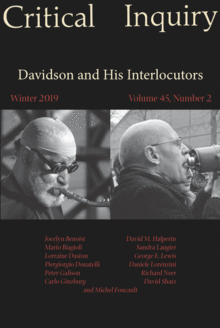
Extrait de l’article, § 10, pp. 389-391
La confrontation de Carlo Ginzburg (1939-2026) avec Saussure ne commence pas avec cet article. Déjà dans « Spie. Radici di un paradigma indiziario » (1979 ; paru en fr. dans Le Débat 6/6, 1980, pp. 3-44, texte complet disponible sur cairn.info) Saussure est une absence parlante : la linguistique y figure comme la « notable exception » contre laquelle Ginzburg construit, par contraste, la généalogie du paradigme indiciaire. Toutes les oppositions qui structurent l’essai — individuel contre général, diachronique contre synchronique, signe motivé contre signe arbitraire — dessinent à contre-jour la silhouette théorique du modèle saussurien. Saussure n’y est jamais nommé, mais il est partout. « Medals and Shells » serait alors le moment où, quarante ans plus tard, Ginzburg finit par nommer le fantôme — et, du même geste, le soumet à sa propre méthode.
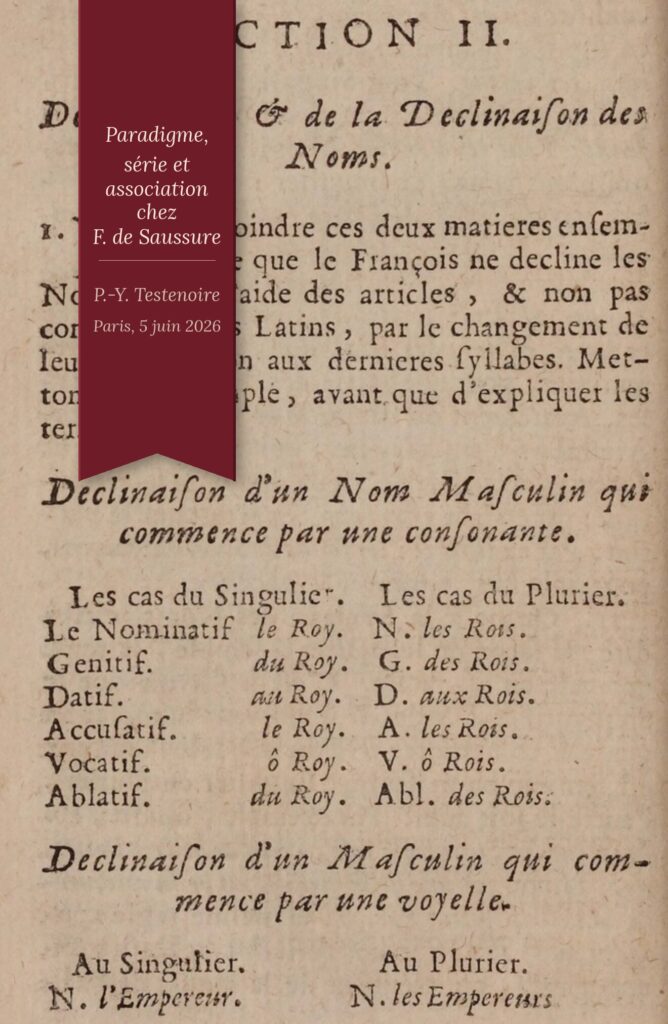
Parmi les dualités héritées de la lecture du Cours de linguistique générale, le couple syntagmatique/paradigmatique est sans doute celui dont la validité a été la moins remise en cause. Or, cette dualité est une réélaboration postérieure, due notamment à Hjelmslev. L’enseignement saussurien oppose aux rapports syntagmatiques, les rapports, non pas « paradigmatiques », mais « associatifs ». La nuance est de taille, puisque F. de Saussure réserve le terme de paradigmeau cas restreint des flexions nominales et verbales des langues indo-européennes. Paradigme et association proviennent, par ailleurs, d’univers conceptuels distincts : de la description grammaticale, pour le premier, de la psychologie et de son assimilation par les théories linguistiques des années 1870-1880 (H. Paul, M. Kruszewski), pour le second. Les deux termes sont articulés dans les écrits saussuriens à l’aide d’un troisième terme, dont la source est plus indéterminée : celui de série. L’exposé consistera en une enquête sur ces trois termes – paradigme, série, association – dans les écrits de Saussure. On s’attachera à montrer comment les trois notions contribuent à la réflexion sur les « entités abstraites », centrale dans la conceptualisation saussurienne de la langue.
Aujourd’hui, le Cours de linguistique générale fête ses 110 ans.
Comme l’a découvert Estanislao Sofía (Cahiers Ferdinand de Saussure 69, 2016), le 19 mai 1916, l’éditeur Payot écrivait à Charles Bally (BGE. Ms. fr. 5011, f. 161) :
Monsieur, le « Cours de Linguistique générale » paraît aujourd’hui en librairie. Il sera dès demain samedi entre les mains de tous les libraires genevois. Vous pouvez donc leur adresser vos étudiants.
Pour célébrer dûment cet anniversaire, la Task Force du site du Cercle a mis le Cours dans une petite centrifugeuse numérique d’où est né le Concordancier Général, un outil qui permet une exploration systématique des paroles du Cours : concordances et KWIC (Key Word in Context), statistiques (profil de mot, comparaison de mots, heatmap des sections), index automatique et hapax saussuriens.
Désormais accessible depuis la rubrique Ressources électroniques de notre site, le Concordancier Général repose aujourd’hui en grande partie sur un traitement automatique du texte. Le travail de balisage en cours permettra de l’enrichir progressivement d’index analytiques (noms propres, lieux, œuvres, termes-clé…) et d’autres diableries modernes.
N’hésitez pas à signaler à la Task Force les éventuelles anomalies (erreurs de texte, erreurs d’indexation, passages mal découpés). Le Concordancier Général est imparfait, mais d’ores et déjà opérationnel : vous pouvez donc lui adresser vos étudiants !
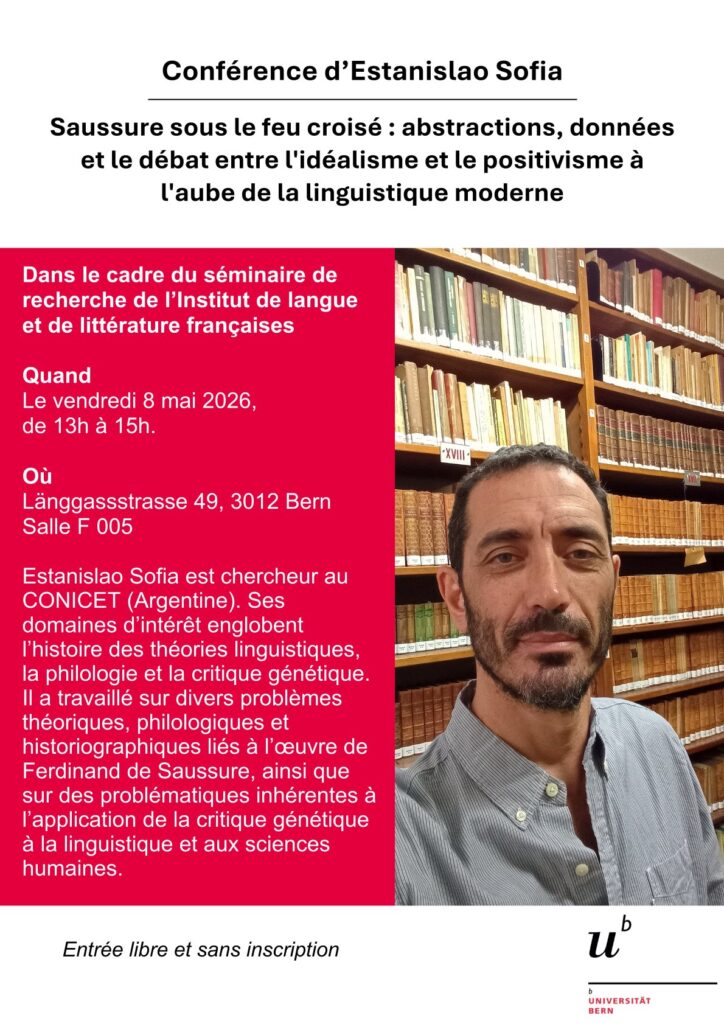
Dans le cadre du séminaire de recherche de l’Institut de langue et littérature françaises de l’Université de Berne, Estanislao Sofía donnera une conférence intitulée « Saussure sous le feu croisé : abstractions, données et le débat entre l’idéalisme et le positivisme à l’aube de la linguistique moderne ».
🗓️ Date et heure : vendredi 8 mai 2026 • 13h15 – 15h (heure de Berne) 📍 Lieu : Länggassstrasse 49, 3012 Berne (Salle F 005, Unitobler) 🎓 Responsable scientifique : Anne-Gaëlle Toutain (Université de Berne / Laboratoire HTL) 🎟️ Entrée libre 💻 Également en ligne (inscription obligatoire, voir ci-bas)
Dans cette conférence, Estanislao Sofía examine la réception du Cours de linguistique générale (1916) sous un angle un peu oublié : celui du débat entre l’idéalisme et le positivisme à l’aube de la linguistique moderne. L’auteur s’attache à décrire comment les partisans de l’idéalisme linguistique (tels que Karl Vossler, Amado Alonso ou Benvenuto Terracini) ont accueilli l’œuvre de Saussure, en la confrontant aux lectures de ses contemporains plus traditionnels. L’étude s’articule autour de deux points majeurs : • Le positionnement de Saussure vis-à-vis du positivisme, une étiquette qui lui est paradoxalement attribuée par les idéalistes alors que d’autres lecteurs lui reprochent simultanément un penchant pour l’abstraction. • La validité de la distinction entre langue et parole, utilisée par Sofía comme échantillon pour comparer les cadres épistémologiques de l’époque. L’analyse de Sofía invite à une réflexion sur la définition même du « donné » et des « données » en linguistique et sur le rapport que chaque courant entretient avec la réalité observable. En explorant ces tensions doctrinales, l’auteur interroge les critères de scientificité revendiqués par l’idéalisme face à l’édifice théorique saussurien.
Estanislao Sofía (photographié ci-contre devant son mur d’escalade préféré) est chercheur au CONICET (Argentine). Ses domaines d’intérêt englobent l’histoire des théories linguistiques, la philologie et la critique génétique. Il a travaillé sur divers problèmes théoriques, philologiques et historiographiques liés à l’œuvre de Ferdinand de Saussure, ainsi que sur des problématiques inhérentes à l’application de la critique génétique à la linguistique et aux sciences humaines.
⚠️ Pour suivre la conférence en ligne, inscrivez-vous avant le 6 mai en renseignant votre nom et votre e-mail dans le formulaire ci-dessous. Le lien de connexion vous sera envoyé peu avant.
Les inscriptions sont closes. Désolé !
Pour toute question → page Contacts.
Nous utilisons des cookies pour vous garantir la meilleure expérience sur notre site web. Si vous continuez à utiliser ce site, nous supposerons que vous en êtes satisfait.