John E. Joseph, « Schizolinguistics, from Tuczek’s Analyse einer Katatonikersprache (1921) to Wolfson’s Le Schizo et les langues (1970) », Language & Communication 106 [2026], pp. 13-29 ; publié en ligne le 5 décembre 2025.
Libre accès : https://doi.org/10.1016/j.langcom.2025.10.006
Abstract : Attempts to diagnose schizophrenia have been grounded in theories concerning what linguistic deviance reveals about mental function. Tuczek’s patient ‘Frau M.’ was institutionalized for using a language which mixed German and French elements. The psychiatrist Goldstein cherry-picked her utterances to support his advocacy of frontal lobotomy. Louis Wolfson was subjected to electroconvulsive therapy for his intolerance of hearing or seeing English, his mother tongue. His book lays out his phonetic and translinguistic strategies for converting English utterances into other languages. The evidence provided by these cases of schizolinguistics are significant for present-day understanding of the psychology and philosophy of language.
[…]
Wolfson figures […] as one of five writers whose ‘logophilia’ is analyzed by Pierssens (1980), along with Jean-Pierre Brisset (1837–1919) (see Brisset, 1878), Stéphane Mallarmé (1842–1898), Roussel […], and Saussure. The only published English translation of part of an article by Wolfson, to my knowledge, is the brief Wolfson (1978), the introductory note to which says that it is the conclusion to his new version of Wolfson (1970), ‘to be called Point final à une planète infernale (“Full stop to an infernal planet”)’.
Pierssens repeatedly juxtaposes Wolfson and Saussure, saying for instance that
Like Mallarmé, Saussure, and Roussel, Wolfson comes face to face with something like a transcendence, an enigmatic being which effects the collusion of a desire and a form. This elusive phantom, some aspect of which escapes from every grasp, whether it be that of science, literature, or whatever, is the sign. (Pierssens, 1980: 60)
Pierssens, along with Sylvère Lotringer (1938–2021) and many others in the 1970s, believed that Saussure’s search for anagrams as a hermetic technique used by poets since ancient times is symptomatic of a madness on his part, which was subsequently cured when he formulated his theory of the linguistic sign. This is important to ponder, because their treatment of Saussure parallels the diagnosis of Frau M. as catatonic and of L∗∗∗∗ as schizophrenic, along with all the others so diagnosed by Goldstein and his fellow psychiatrists. Pierssens actually labels Saussure as ‘schizophrenic’ and ‘paranoiac’ alongside Wolfson.
Wisdom and madness, what is born of the encounter between the sign and desire produces both delight and anguish, despair and hope. [ …] Wolfson roams through Manhattan and even finds a fraternal prostitute; Saussure believes in the solidarity of poets.
Extrait de l’article (§ 3) ; les références sont disponibles à ce lien.
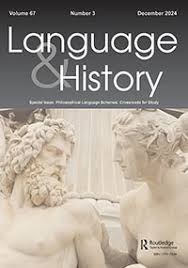
Cristina Altman, «Saussure and the Brazilian ‘scientific grammar’ (1880–1930)», Language & History, publié en ligne le 18 Aout 2025. Libre accès : https://doi.org/10.1080/17597536.2025.2535231 L’article est également disponible en PDF.
Since his earliest studies on Saussure and some of his contemporaries’ theories, notably those of William D. Whitney (1827–1894) and Herman Paul (1846–1921), Konrad Koerner consistently maintained that Saussure proposed ideas, both in his Mémoire ([1879] 1987), and in his Cours (1916), in agreement with, or in response to, the intellectual climate of his time. So much so that for Koerner, Saussure’s real value lay more in his capacity to synthesise the ideas that were circulating at the end of the nineteenth and the beginning of the twentieth centuries than in being the first to advance certain concepts, perceived as innovative by various of his later readers (cf. Koerner 1971/1973; Koerner 1988, 2020).
In the Brazilian grammatical tradition, the first mention of Saussure is attributed to the celebrated Brazilian philologist Manuel Said Ali Ida (1861–1953), in the second edition of his Dificuldades da Língua Portugueza (Rio de Janeiro: Besnard Frères, 1919), as translated below:
I have always taken into account, in the various questions I have dealt with, the psychological element as a very important factor in language changes and, investigating the persistence or the instability of linguistic facts, I have taken the Portuguese language as my field of research not only from the literary period that extends from João de Barros1 to Manoel Bernardes2 but also its modern speech and its less studied medieval forms. I was thus able to gather results that give a regular idea of the evolution of the Portuguese language from its emergence to the present moment, from which we can see the reason for [the existence of] certain double dictions,3 which sometimes coexist, sometimes substitute each other, [which has often been] the source of fierce and futile controversies. In these facts, I believe, F. de Saussure would find plenty of material with which to reinforce his luminous assessments of synchronic linguistics and diachronic linguistics. (Ali & Manuel [Ida] 1919: VI, emphasis added)4
So, for Said Ali, one of the Portuguese language’s particularities, regarding the divergent forms (‘double dictions’), one popular, and one erudite, could be easily explained if the linguist, instead of legislating, observed them over a period. A form considered popular, or incorrect, at a certain stage of the language evolution, could be the standard in a later stage. No useless controversies were needed, and these facts support Saussure’s appraisals on synchronic and diachronic linguistics, Said Ali concluded.
Some historiographers in Brazil have given this isolated mention of Saussure an anachronistic interpretation, notably Mattoso (1961/2004: 224), followed by Bechara (1962, 2008) and, more recently, Cavaliere (2018), who saw in Ali a visionary anticipation of the structuralist framework.
In a comprehensive study on the early beginnings of European structuralism, Koerner (1975: 724) rightly observed that no linguist would seriously claim that language is not in some way organised and is merely a conglomerate of isolated terms. In this sense, all linguists would be ‘structurally oriented’ to a certain extent. But being structuralist as we have come to understand it today cannot be applied to Ali’s grammatical writings, any more than to any of his contemporaries in Brazil at the end of the nineteenth century. Rather than a precursor of what would become the structuralist framework, Said Ali was a synthesiser of the normative, pedagogically oriented grammatical tradition and the new demands for a scientifically oriented grammar building on a historical-comparative form.
Extrait de l’article («Introduction ») ; les références sont disponibles à ce lien.
John E. Joseph, « Koerner, Saussure, Chomsky: an eternal upbraiding of the ‘Great Man theory’ », Language & History, publié en ligne le 14 aout 2025. Libre accès : https://doi.org/10.1080/17597536.2025.2535222 L’article est également disponible en PDF.
For his doctoral research, Koerner was fortunate to have the manuscript resources provided by Robert Godel (1902–1984) (Godel 1957) and the first volume of the critical edition of the CLG by Rudolf Engler (1930–2003), as well as the annotated Italian translation of the CLG by Tullio De Mauro (1932–2017), with De Mauro’s notes and additional material not appearing in French translation until 1972. This additional material includes a biography of Saussure that is extraordinarily rich given what limited material was available at the time. One of its key sources was an autobiographical account by Saussure which Godel had published (Saussure 1960), and which was accepted unquestioningly – until another half dozen versions that Saussure drafted came to light, in which some key events are related differently, making it impossible to take everything it says at face value2. Nevertheless, it offered insights into Saussure’s background and character that would remain unique until his correspondence became public, starting with Benveniste (1964). The abstract to Koerner (1971a) states that whilst his study ‘constitutes a contribution to general linguistic theory and to the history of linguistics’, he has chosen to centre it on Saussure on account of three ‘traditional assumptions’, which, however, Koerner does not accept: – Saussure has been almost unanimously regarded as the founder of modern structural linguistics; – his posthumous Cours de linguistique générale has generally been interpreted as a complete break with previous theories of language, in particular those of the Junggrammatiker, and – modern linguists have tended to regard his achievements as the creative act of a genius who was completely independent of the intellectual atmosphere of his time. (Koerner 1971a, iii). He declares that, ‘because our own findings do not confirm this’, he will challenge not merely these assumptions but the entire ‘manner in which the history of linguistics has been written’ (ibid.). It was no empty boast. What Koerner opposes is, above all, historical discontinuity, which tends to go hand in hand with the ‘Great Man theory’ of history. The discontinuity can be both diachronic, as in (2) above, and synchronic, as in (3). The ‘Great Man theory’ is a legacy of the Romantic hero, encapsulated in the dictum that ‘The History of the world is but the Biography of great men’ (Carlyle 1841, 47). Much of Koerner’s work, from the dissertation onward, would be aimed at rescuing and recording the important contributions of men and women who were not generally reckoned to be Great. As for those who were deemed Great, one rarely finds Koerner denying the importance of their work; rather, he aims to show how their giant stature has been achieved by standing upon the shoulders of less famous predecessors and contemporaries.
Extrait de l’article ; les références sont disponibles à ce lien.
John E. Joseph (ed.), The Bloomsbury Handbook of Saussure, New York / London, Bloomsbury Academic, 2025, 416 p., ISBN 978-1-3503-7978-7, 28 bw ill., 175 $ Notice de l’Éditeur, avec table des matières. Ce livre est disponible en ligne sur Bloomsbury Collections (abonnement requis)
To call Ferdinand de Saussure (1857-1913) the father of modern linguistics, and one of the two parents of semiotics, is obviously metaphorical, and while founder may seem less so, in a literal sense Saussure never founded anything. His contributions to modern semiotics amounted, in its formative period, to a few pages – incredibly rich pages, but sparse. If modern linguistics is Saussurean, he never saw it practised, apart from his own lectures and the masses of manuscripts he left unpublished, with small hints of it in some of his publications. The latter do not include that foundational document of modern linguistics, the Cours de linguistique générale (Course in General Linguistics, abbreviated henceforth as CLG), which, although it bears his name as its author, he did not compose, let alone publish. The story is well-known of how his colleagues Charles Bally (1865–1947) and Albert Sechehaye (1870–1946) compiled students’ notes of his lectures, along with notes of his own, wrote the book and published it in 1916, three years after his death. He died forgotten by most linguists, despite having once had considerable renown on account of a book which he wrote as a student, when by rights he ought to have been focusing on getting his degree. The Mémoire sur le système primitif des voyelles dans les langues indo-européennes (Memoir on the original system of vowels in the Indo-European languages, 1879) overturned the eld he was studying, and promised a great career – which he then managed to sabotage at almost every opportunity. He recognized this and regretted it, and he died with no expectation of his work being appreciated. That it would not only be remembered but have such a spectacular afterlife, with generations of scholars devoted to its exegesis, is little short of a miracle. This was a man who never believed the science was settled. On the contrary, he thought that very little in the science of language could be accepted at face value. Where the boundaries lay between various basic terms related to language, linguists had not bothered to settle, though some had made an initial effort. Linguists imagined language as starting from a set of sounds, in the way that alphabetic writing was invented to capture, and these sounds then combine to form words, which in turn combine to form sentences. Saussure began by questioning whether sounds as such really matter at all. Rather, what matters is the system they form – a system in which the differences between elements are what count, rather than the sound elements in their own right.
Extrait de la préface par J. E. Joseph, p. XIV-XV.
L’ouvrage sera présenté par John Joseph à l’occasion de l’AG 2025 du Cercle, le 20 septembre à l’Université de Lausanne, salle CD106 du Châteaude Dorigny.
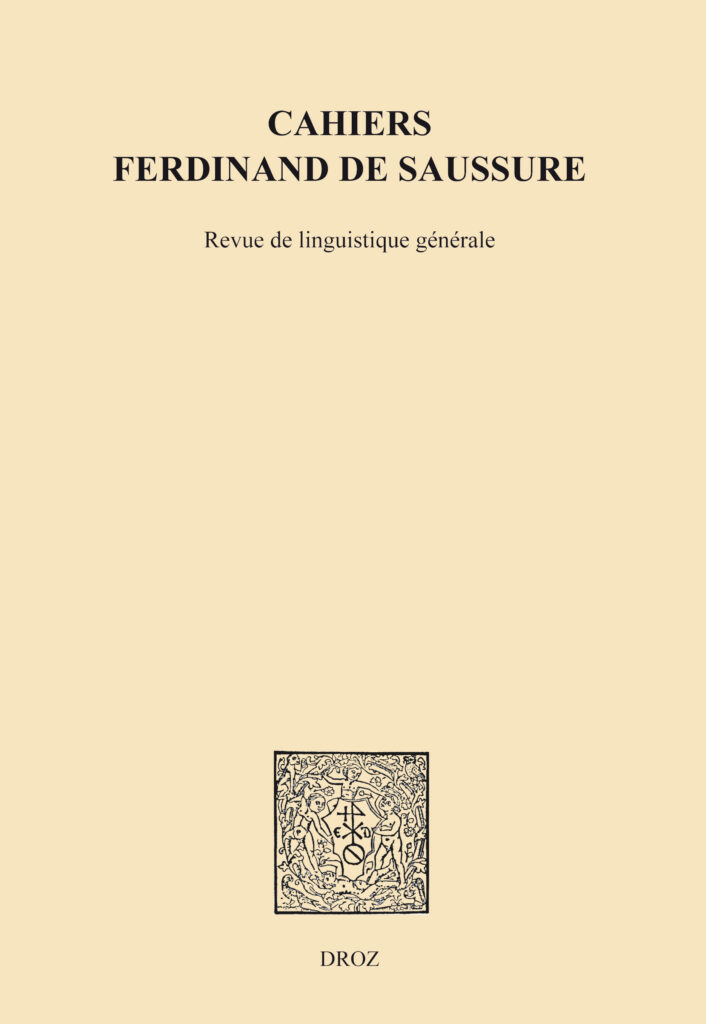
Cahiers Ferdinand de Saussure, volume 76 (2023), édité par John E. JOSEPH, Ecaterina BULEA BRONCKART, Anne-Gaëlle TOUTAIN, Genève, Librairie Droz, 2025, 368 pages, ISSN : 0068-516X, ISBN-13 : 978-2-600-06647-1, € 60,00 Date de première publication : 18 juin 2025 Voir la notice de l’Éditeur. Ce numéro en version numérique : https://revues.droz.org/CFS/issue/view/CFS_76
Table des matières
I Éditorial
John E. JOSEPH, Ecaterina BULEA BRONCKART, Anne-Gaëlle TOUTAIN, À nos lecteurs, p. 5-6
Camiel HAMANS (Adam Mickiewicz University in Poznań), L’importance changeante de l’analogie. Quelques remarques sur l’analogie dans la formation des mots, p. 9-40
Abstract: Analogy is one of the most frequently used terms in the history of linguistics. However, the meaning of the notion differed considerably over the centuries. Consequently, the role that analogy was thought to play in language change also differed substantially. In the first parts of this paper emphasis is on the history of the term analogy, whereas in the final part it will be demonstrated how analogy in its modern sense can be used successfully when applied to non-morphemic word formation. Keywords: Analogy, anomalists, regularity, perception, Schola Hemsterhusiana, Hermann Paul.
Anneli LUHTALA (University of Helsinki), Grammar as a rational art and as an Aristotelian science, p. 41-60
Abstract: In this essay, I have traced the evolution of ancient grammar from an empeiria to a rationalistic art and, during the Middle Ages, further to an Aristotelian science. Throughout this period, grammar continued to borrow tools of analysis from dialectic and Aristotelian physics and became a major subject in the Arts Faculties. All the same, it remained an art which was studied as a means to an end rather than for its own sake. Medieval thought was fundamentally hierarchical, and grammar did not figure among the highest disciplines, which can be studied for their own sake. Keywords: Ancient rationalistic grammar, medieval speculative grammar, ancient syntactic theory, alexandrian philology, empiricism.
Rolf KEMMLER, Synchronic vs diachronic approaches in the descriptions of german nominal inflection in the earliest Portuguese textbooks of the german language (1863-1926), p. 61-83
Abstract: Since the first German language textbook for a Portuguese target audience was published in 1863, the respective authors had to ask themselves not only how to designate the components of the nominal inflection of German nouns, but also how to present them in a classificatory way in order to familiarize their audience with the German declension. Given that the Grimmian diachronic approach was and still is considered authoritative in academic German studies, the question arises as to whether and how the authors of the earliest Portuguese works were guided by this or other approaches. The result will answer the final question of which of the classification approaches might be particularly promising in the context of German as a foreign language. Keywords: German language, Portugal, synchrony, diachrony, Jacob Grimm.
Gonçalo FERNANDES, Carlos ASSUNÇÃO (University of Trás-os-Montes & Alto Douro, Portugal Center for Studies in Letters), 17th-century descriptions of Japanese and Vietnamese and their relevance to the modern politeness principle, p. 83-104
Abstract: The “politeness principle” was coined even before Stephen Curtis Levinson established pragmatics as a linguistic academic field in the early 1980s. However, other relevant works concerning pragmatics were published as early as the 1930s, for example, by Charles Sanders Peirce (1839-1914), Charles William Morris (1901-1979) and Yehoshua Bar-Hillel (1915-1975). On the other hand, there is a common knowledge that Brown & Levinson (1978; 1987) originated the idea of the politeness principle because of the importance of their linguistic politeness studies. Though the 1973 paper by Robin Tolmach Lakoff, “The logic of politeness: Or, minding your p’s and q’s,” can be considered the “birth certificate” of the politeness principle as a linguistic domain, it is often ignored even in specialized papers or books. Based on a 1967 work by Herbert Paul Grice (1913-1988) on the rules of conversation, an as yet unpublished manuscript, Lakoff (1973) summed up the politeness expressions into three rules. Nevertheless, the grammarians and linguists of Asian languages were always particularly interested in describing their relevant expressions and address forms. In 1944, Hsien Chin Hu (Columbia University, New York City) published a pioneering paper concerning “The Chinese Concepts of ‘Face’”, anticipating by 11 years the theory of face in Erving Goffman’s paper “On Face-Work; An Analysis of Ritual Elements in Social Interaction”. 17th-century European grammarians and lexicographers of the Japanese and Vietnamese languages had also aimed to describe the linguistic social relationships’ regulations. In this paper, we study the approaches which three early European grammarians and lexicographers developed to account for the politeness principle in Japanese and Vietnamese in the 17th century, namely João Rodrigues ‘Tçuzu’, S. J. (1562-1633), Diego Collado, O.P. (late 16th century-1638) and Alexandre de Rhodes, S. J. (1593-1660), and their contribution to present-day linguistics. Keywords: History of the Language Sciences, Missionary Linguistics, Address Forms, Face Theory, Jesuits, Pragmatics.
Gerda HASSLER (Université de Potsdam), L’intégration de la catégorie d’aspect dans la description grammaticale, p. 105-127
Abstract: This contribution examines the integration of the notion of aspect in the grammar of European languages, especially in Spanish grammar writing. The hesitant integration of compound verb forms into the description of the conjugation of Romance verbs and the peculiar naming of these verb forms appear to be due to two causes until the 18th century. On the one hand, the authors of the grammars transposed Latin grammar and its terms to the vernacular languages. On the other hand, the authors considered the terms only from a semasiological perspective, deriving the functions of the verb forms from the meaning of the terms. Keywords: Aspect, verbal system, imperfect, completed, definite, indefinite.
Ricardo CAVALIERE, On the profile of Brazilian Portuguese grammar in the 20th century, p. 129-150
Abstract: This work deals with the concept of grammar in Brazil in the 20th century, with special attention to its theological role, the nature of its corpus and the limits imposed on the task of describing the language system in relation to other factors such as variations in language use and style. The study also presents a typological classification of Brazilian-Portuguese grammars throughout the century, based on their profile, their theoretical sources and the corpora they use in their linguistic descriptions. Keywords: Portuguese Grammar, 20th Century, Brazil.
Jesse LUNDQUIST (Princeton University), Saussure on *téi-stems: a generativist avant la lettre?, p. 151-172
Abstract: This paper highlights one remarkable aspect of Saussure’s account of the Proto-Indo-European *tei-/ti-stems: he used an inherently accented morpheme for his reconstruction, viz. an underlyingly accented *-téi-. Based on an analysis of a neglected passage from the end of the Mémoire, and introducing more explicit statements from his posthumously published courses on morphology and on Gothic, I propose that Saussure devised a budding compositional system of morphophonological analysis. I suggest that his underlyingly accented morphemes indicate two levels of abstraction in phonology, forms before and after modification, a remarkable move that foreshadows similar analyses in generative grammar. I focus on his account of Indo-European *-téy-, which remains valuable in assessing this particularly contentious realm of Indo-European morphology, namely accent and ablaut. Keywords: Accent and ablaut, morphophonology, underlying representations, ti-stems.
John E. JOSEPH (University of Edinburgh), Ferdinand de Saussure, le post-structuraliste, p. 173-184
Abstract: Understanding the linguistic work of earlier times demands that it be read in the context of when and why it was written. This effort is both aided and impeded by our habit of packaging the past into periods and doctrines that entail inevitable oversimplifications and distortions. This paper contends that structuralism is conceived in such a distorted way – including the view that we are supposedly “post” it. Inspired by a student who referred to Saussure in an exam as a post-structuralist, I take up the case for seeing him as exactly that, in terms of how we generally conceive of structuralism, with a view to improving our understanding of what structuralist linguistics was – indeed, perhaps still is. Keywords: Ferdinand de Saussure, structural linguistics, structuralism, post-structuralism, Henri Meschonnic, J. R. Firth, Jacques Derrida, Maurice Merleau-Ponty.
III Lectures critiques
Sébastien MORET, Saussure en espéranto. À propos de la première traduction du Cours de linguistique générale en espéranto, p. 187-206
Reinier SALVERDA, A global survey and corpus of translations of Saussure’s Cours (1928-2014) and Écrits de linguistique générale (2002-2021), p. 211-238
Unde venis et quo tendis ? Conférences sur l’histoire de la linguistique et de la sémiotique, Université Palacký, Olomouc, automne 2023 (Israel Chávez), p. 347-351
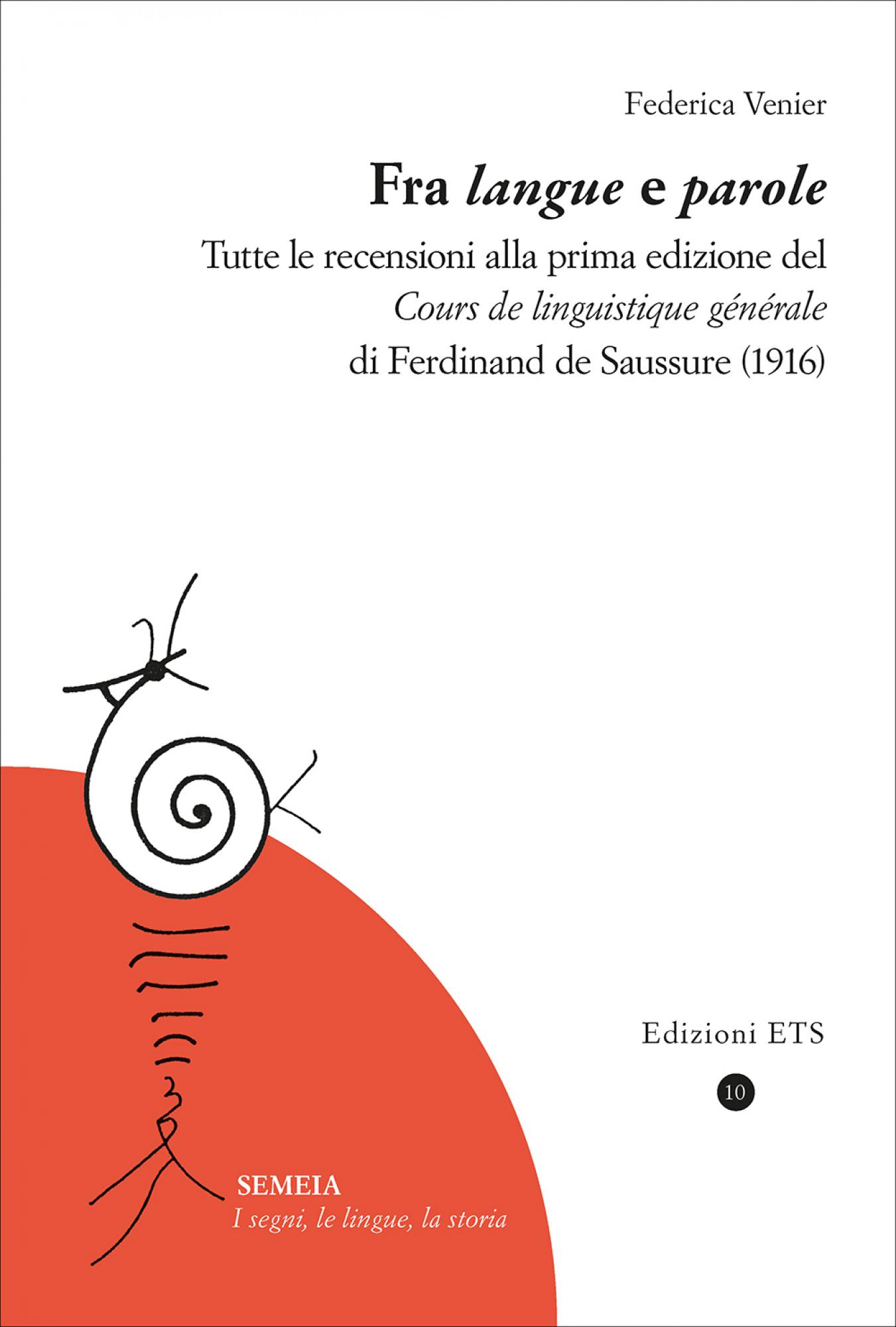
Federica Venier, Fra langue e parole. Tutte le recensioni alla prima edizione del Cours de linguistique générale di Ferdinand de Saussure (1916), Pisa, Edizioni ETS (Semeia. I segni, le lingue, la storia, 10), 2025, 236 p. ISBN 9788846770073, 24 € Notice de l’Éditeur, avec table des matières (avec liste des comptes rendus) et introduction
Premesso che le recensioni sono di varia dimensione e di vario valore e sono state dunque diversamente annotate, condividerei comunque con chi mi legge alcune impressioni su quanto mi pare di particolare interesse in questa raccolta. Il fatto più importante mi sembra essere costituito dalla fitta rete di relazioni che ne emerge. In primo luogo troviamo infatti i recensori stessi, tutti linguisti illustri e noti al loro tempo ma forse oggi non più così presenti. L’unica eccezione in questo gruppo è costituita da Benjamin Bourdon, noto psicologo che in effetti per il suo pubblico redige piuttosto un riassunto che una recensione. E ricordiamo che Sechehaye stesso scriverà, nel 1917, un potente riassunto dell’opera saussuriana per la «Revue philosophique de la France et de l’étranger», articolo che ovviamente non può essere considerato una recensione, dato il ruolo svolto dallo studioso nella redazione del Cours ma che, come lo scritto di Bourdon, attesta l’interesse a diffondere il contenuto dell’opera al di fuori dei circoli dei linguisti. A loro volta poi gli illustri recensori, già in se stessi testimoni del dibattito allora in corso, rimandano a molti altri studiosi, spaziando dalla linguistica alla psicologia, alla sociologia, all’etnografia, ecc. […] In secondo luogo, sempre restando all’interno di una prospettiva storica, mi pare rilevante la sottolineatura della problematicità della relazione di Saussure con i Neogrammatici e, in particolare, con Paul. Il violentissimo attacco di Jespersen, che, come si vedrà, afferma che il Cours de linguistique générale avrebbe avuto un senso prima dei Prinzipien der Sprachgeschichte (1880) ma non dopo più di un trentennio da quell’enorme lavoro, fa riflettere e induce a interrogarsi anche sulla diversa fortuna presso i posteri delle due opere.
Extrait de l’introduction, p. 3-4.
Federica Venier ha insegnato Linguistica italiana presso l’Università di Bergamo. Da tempo si dedica alla storia del pensiero linguistico. È autrice di numerosi saggi e volumi, di cui ricordiamo, in particolare, La presentatività. Sulle tracce di una nozione (Edizioni dell’Orso, 2002), ll potere del discorso. Retorica e pragmatica linguistica (Carocci, 2008), La corrente di Humboldt. Una lettura di La lingua franca di Hugo Schuchardt (Carocci, 2012) e Appunti di viaggio. Percorsi linguistici fra storia, filologia e retorica (FrancoAngeli, 2017). Nello stesso filone storiografico della sua ricerca si colloca anche quest’ultimo volume.
Nous utilisons des cookies pour vous garantir la meilleure expérience sur notre site web. Si vous continuez à utiliser ce site, nous supposerons que vous en êtes satisfait.